Among Friends. Collar ID, by Walt Anderson
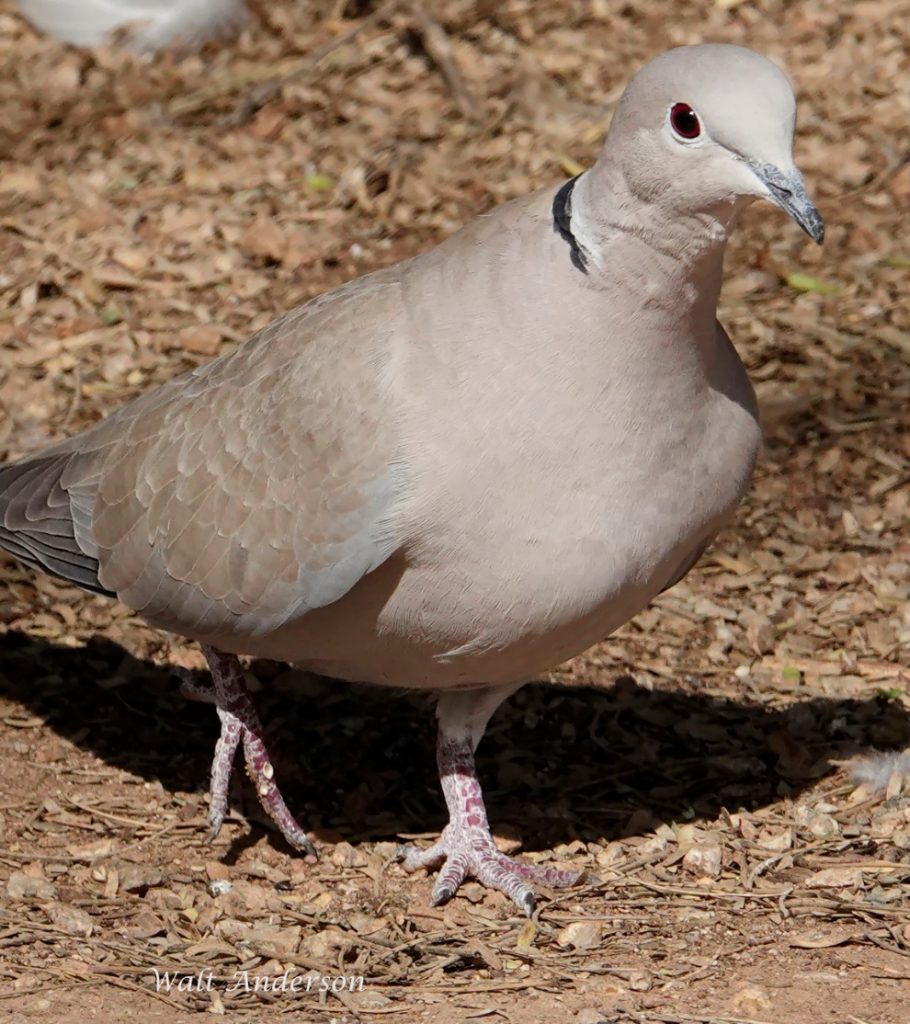
I awoke shortly before dawn this morning to a mournful sound, “hoo-HOOOO-hoo,” repeated over and over again. Twenty years ago, I would not have heard this. The caller was a Eurasian Collared-Dove, which, by its very name, implies a bird not native to North America. First seen in Florida in the late 1970s, the birds multiplied faster than rabbits, swarming across the continent with astonishing speed, reaching Arizona in 2000 and even attaining Fairbanks, Alaska in recent years. I first photographed the bird in 2010. The spread was so fast that most of the general public was unaware of the newcomer, sometimes assuming that White-winged Doves were winging northward beyond their existing range.
We are experiencing an anti-immigrant trend in this country involving non-native plants and animals, including humans. There can be serious debate about whether or not this is justified, and I won’t get political here. However, the story of the Eurasian Collared-Dove is a fascinating one, so let’s do a little collar ID.
#dove #eurasiancollareddove #collareddove #immigration #breedingbirdsurvey #commensal #jumpdispersal #mourningdove #namingconvention #parkesrule #collaredpeccary
Originally found in India, Pakistan, and into parts of China, the Eurasian Collared-Dove spread slowly at first, but by the 1930s, it expanded westward into Europe at breakneck speed, reaching Norway in 1954, Ireland in 1959, and Spain and Portugal in 1974.
It was introduced from China to Japan in the 18th or early 19th century, where it became abundant in the Tokyo plain, but when subjected to intense hunting pressure, its population dove to near extinction (“dove” is a funny word, sounding like “doughve” or “duhve” depending on usage). A small population persists today in that part of Japan.
Escapees from captivity in the Bahamas in the mid-1970s started the expansion across North America, first to Florida, then to most of the continent, including Mexico, wherever humans provided conditions that suited its needs.
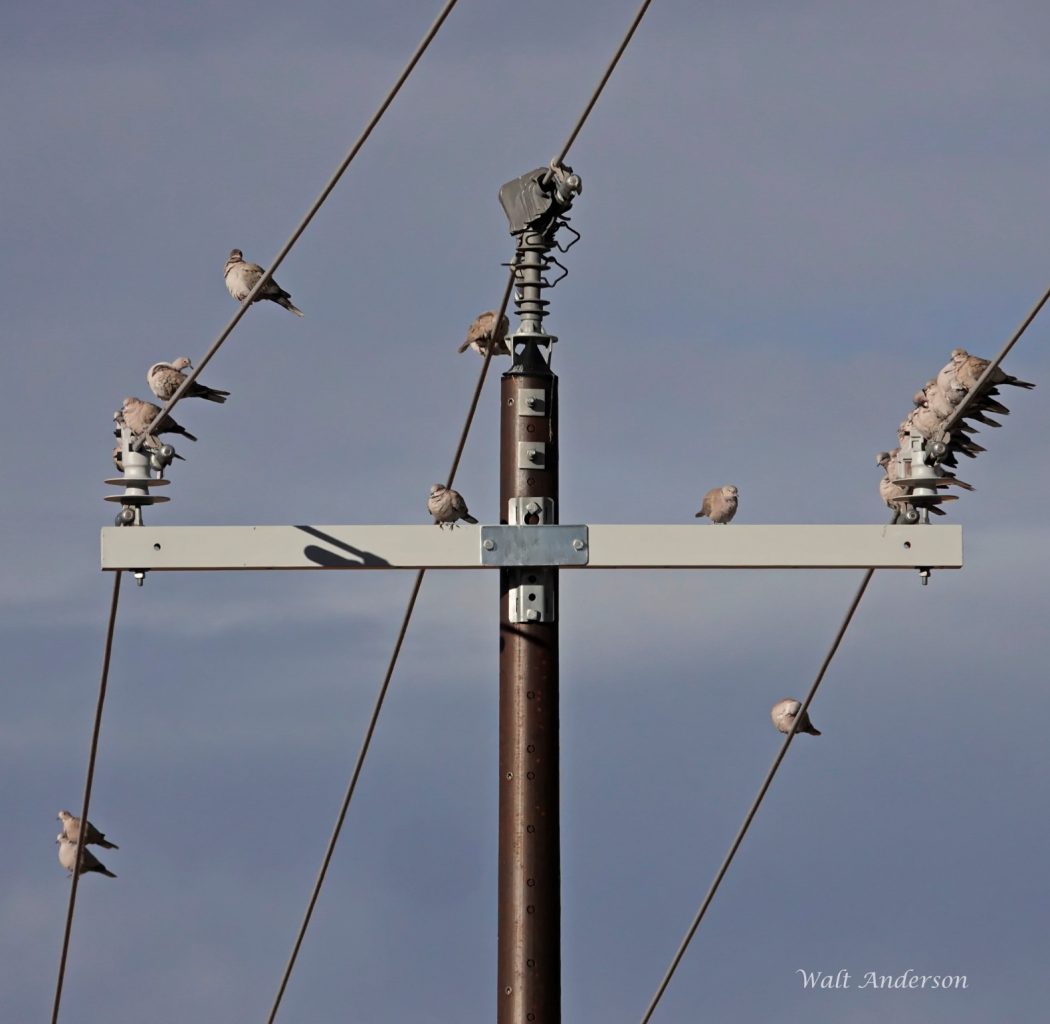
The Eurasian Collared-Dove is a human commensal, rarely nesting far from human habitation. I recently did a Breeding Bird Survey (50 stops of 3 minutes each over 25 miles) in a remote part of Yavapai County, Arizona. We started in national forest, but collared-doves didn’t show up until the first houses did. It didn’t matter if it was a traditional ranch or a McMansion—those low-pitched calls were reliably there. The birds are gregarious, and powerlines are simply part of their habitat. Sometimes they share those lines with another human commensal, the Rock Pigeon, though the latter will even live in intensely urban settings of concrete and steel at which the collared-dove turns up its beak.

This bird loves residential areas, yards, gardens, fields, and farms while avoiding natural deserts, high mountains, and dense forests. Suburbia is superb.
Ecologists were concerned that these non-natives might depress populations of native pigeons and doves, but that doesn’t seem to have happened. They may fit an “open niche,” which Mourning Doves often share with little apparent disagreement. There is no “great replacement theory” here.

Golf courses are perfect. I’ve heard that in some areas, so many of these doves feed on the ground that they call these areas collared greens.
All right, I made that up.
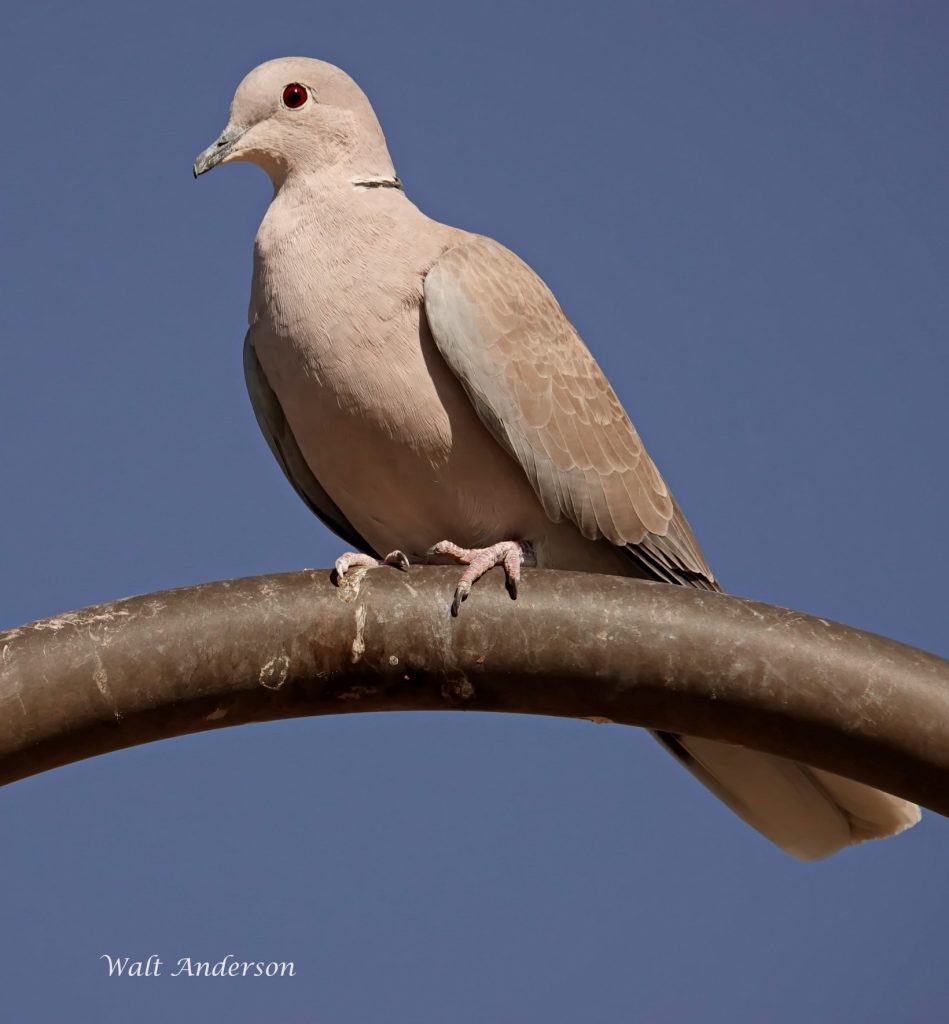
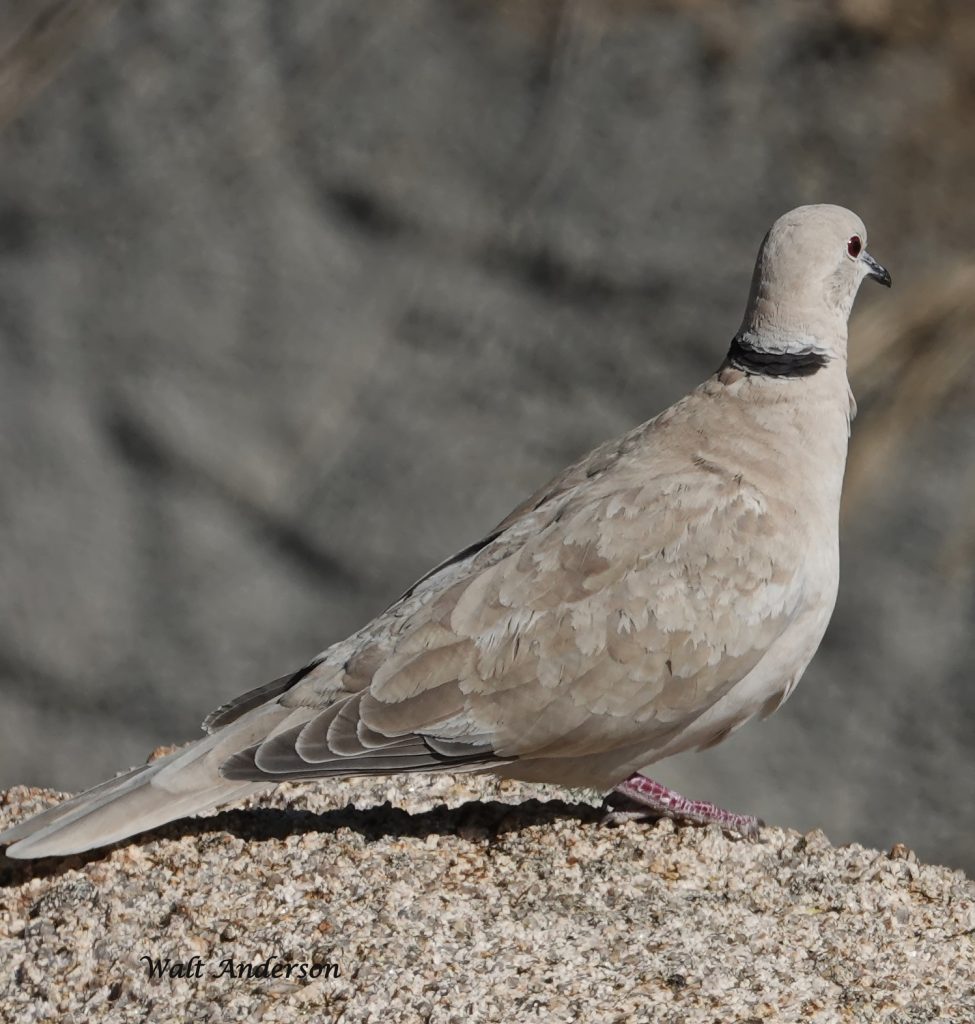
At first glance. You might think that all of these birds are alike, but there are subtle differences. This is a male, whose dove coat has a pinkish tint with a black collar bordered with thin strips of white.
This female lacks the rosy tint and has thin gray stripes bordering the black collar. Subtle distinctions, yes, but they can tell the difference.
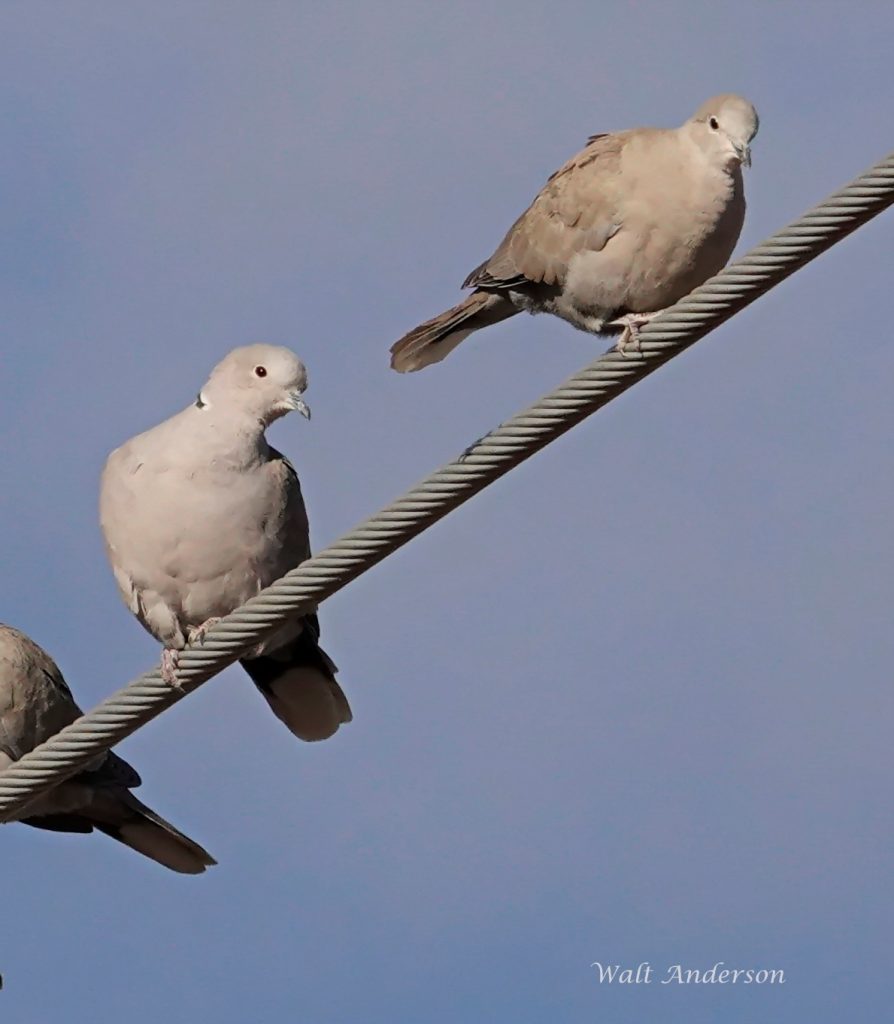
Juvenile birds (here on the right) have no or minimal collar, and they are a bit darker, closer in coloration to that of a Mourning Dove. I’ll compare them farther later.
Doves in general lay two eggs per nest, so how in the world did they spread so rapidly around the northern hemisphere? Well, they don’t waste any time starting the next clutch, sometimes laying a new batch even while tending young. Three to four clutches per year are common, and up to six clutches in a year can happen if food supply is adequate. Birds hatched even in late summer can start their own families right away the next spring. While older birds are sedentary (non-migratory), young birds seem to have a wanderlust, and dispersers can show up hundreds of miles away from known nesting sites, after which intervening land fills in with more birds. This is called “jump dispersal,” and they are the ultimate immigrant.
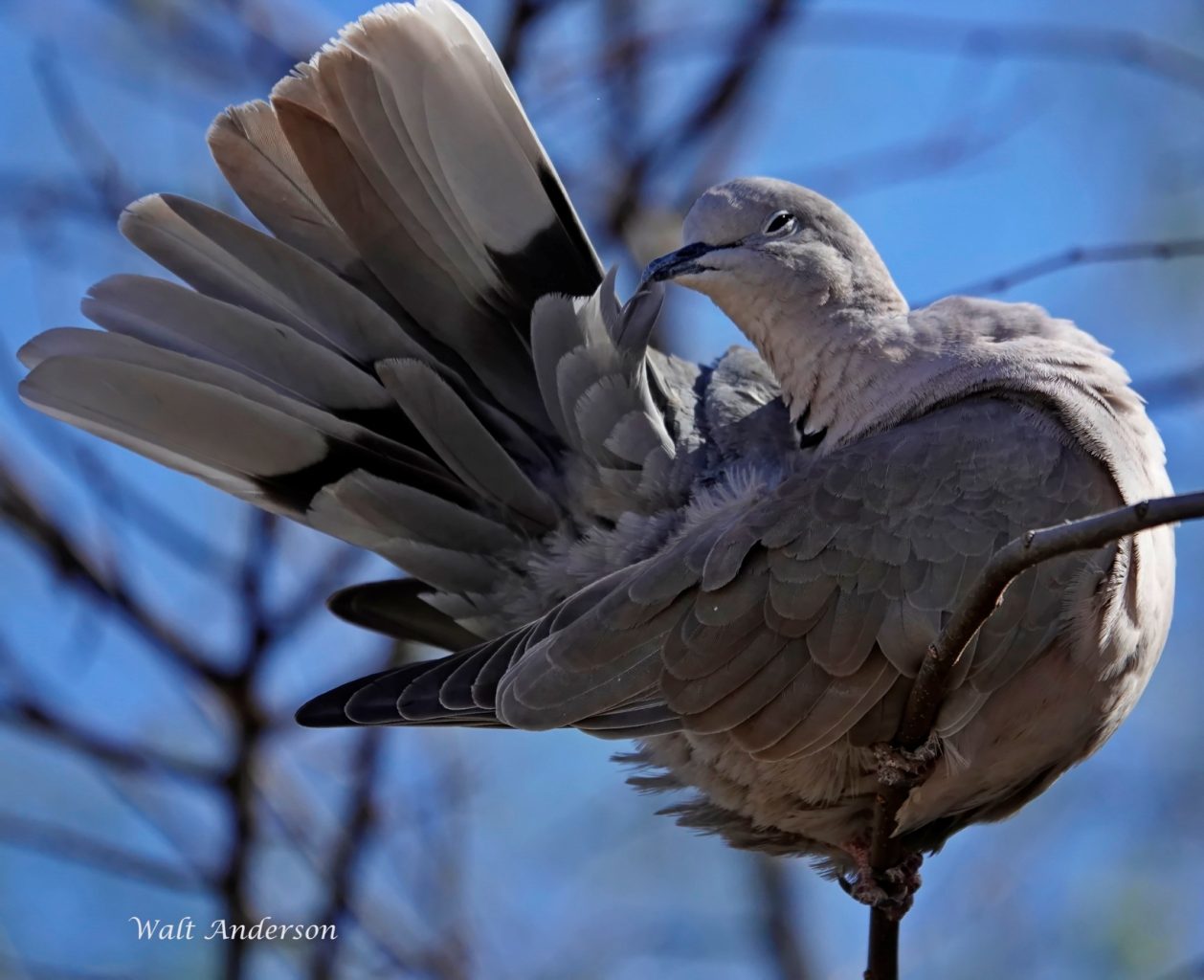
When the bird flies or preens, you can see that it has a broad pale band under the tail contrasting with a black base. The wings are tricolored: brown at the shoulder, then pale gray on the secondaries and primary coverts, then blackish on the primaries themselves. Don’t for a minute think that their primary colors are red, yellow, and blue.
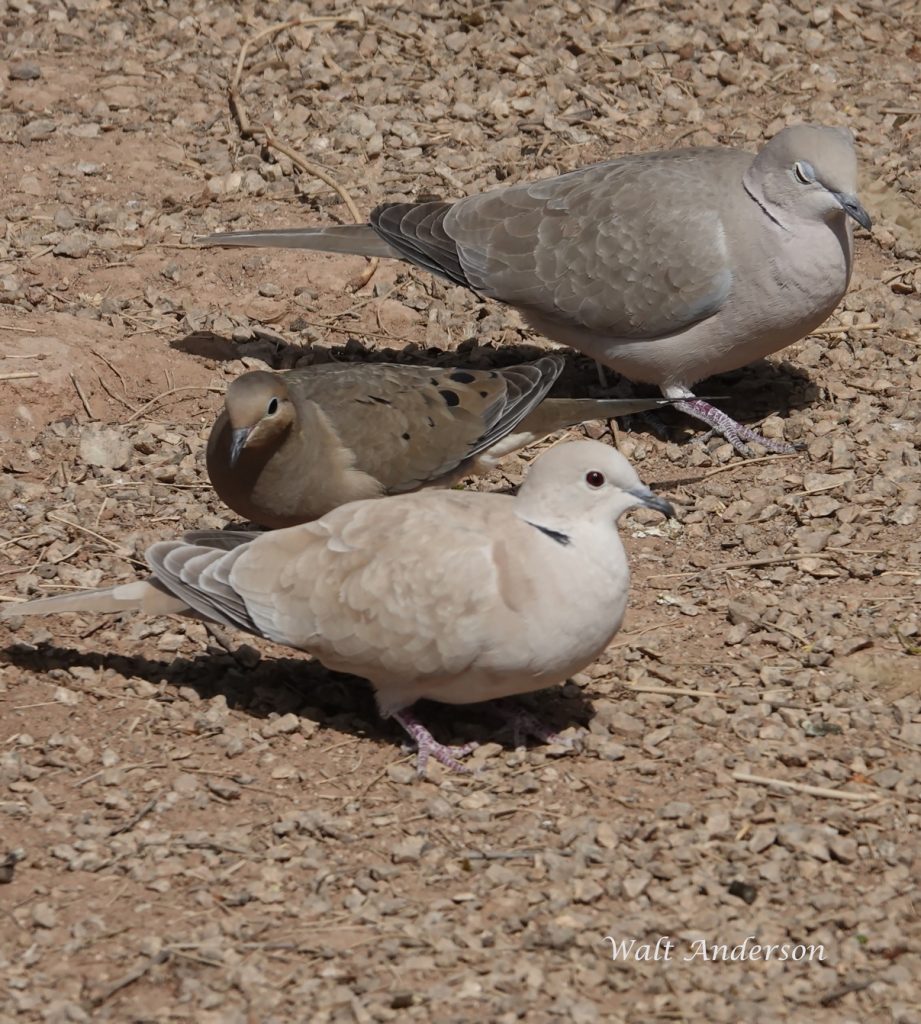
Good birders rely on vocalizations as much as visual characters for caller ID, and that applies to doves, as well. However, when you have three species together like this, it is easier to distinguish them. The Eurasian Collared-Dove is the hunk in the back, larger even than its relative, the African Collared-Dove, in the foreground. The petite and darker Mourning Dove is in the middle.
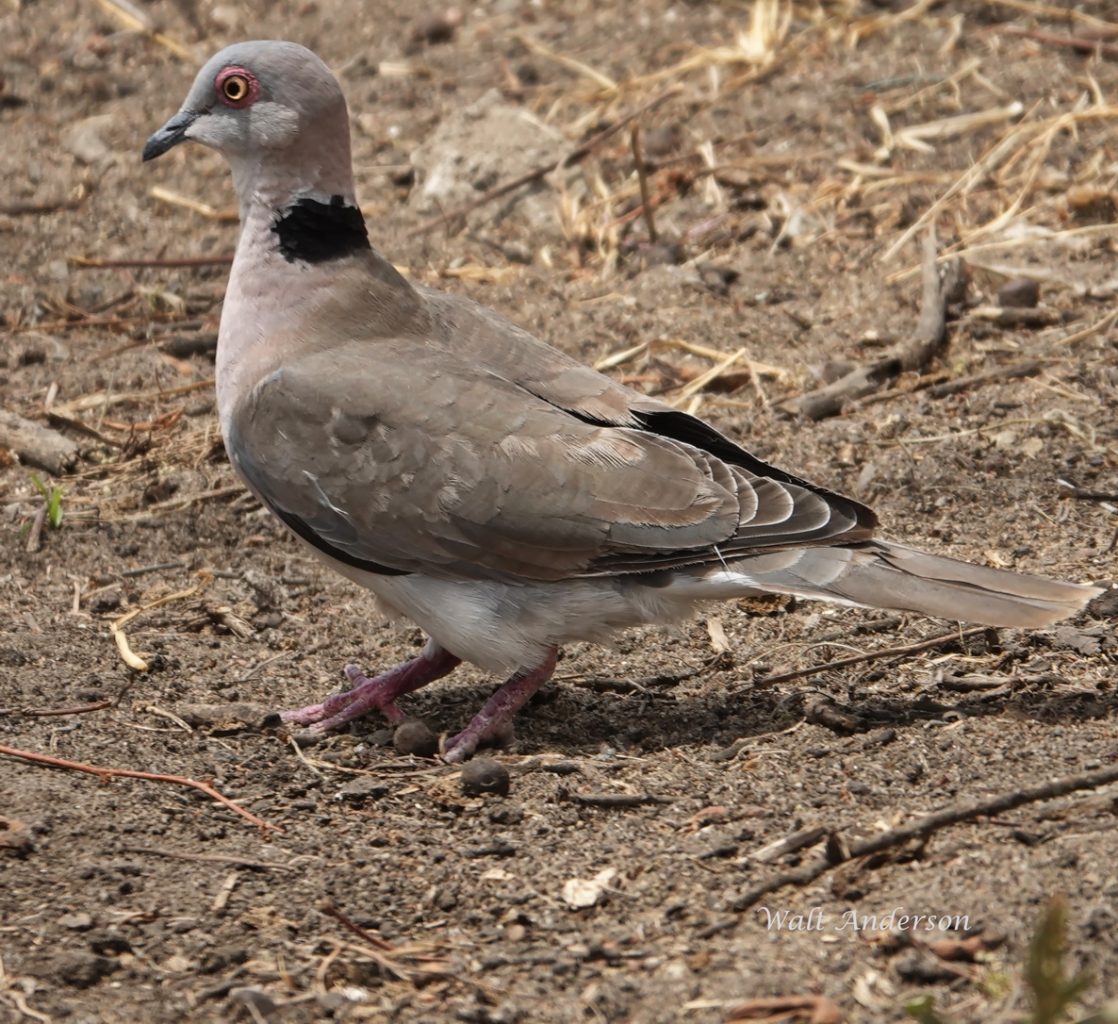
If you go to Africa, as I often do, you’ll see yet another close relative, the Mourning Collared-Dove. Notice its broad, black collar and pale eye with red orbital ring. “Mourning” is simply an adjective describing its call. It is not closely related to our Mourning Dove.
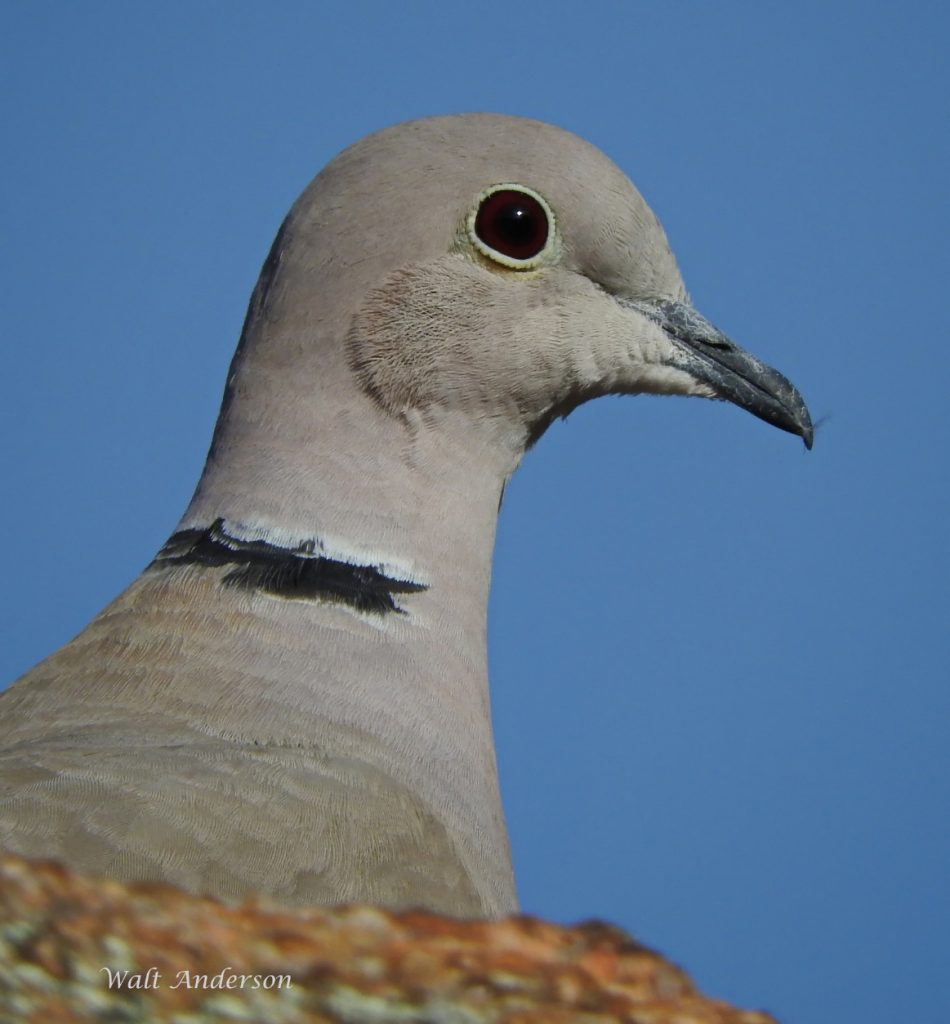
Perhaps I should explain the naming conventions I am using. Each species has a scientific name consisting of the genus (capitalized) and species (not capitalized); both are in italics or underlined. Ornithologists settle on an accepted common name, and if it is unique to a species, it is a proper noun and is capitalized. This prevents confusion from the mere use of an adjective (like a gray vireo) from a recognized species (the Gray Vireo). We acknowledge the Mourning Dove as a real entity, while we may refer to doves in general.
Using what is called “Parke’s Rule,” we do not use capitals when a compound word involves a misnomer; for example, a Western Meadowlark is not actually a lark. On the other hand, a Western Screech-Owl is indeed an owl, and the Eurasian Collared-Dove is indeed a dove, so the second word is capitalized. When a common name is merely a compound adjective, the second word follows a hyphen but is not capitalized; for example, Ring-necked Dove is an African species that is named for its ringed neck. Great Horned Owl has no hyphen, since it doesn’t have a compound adjective (the horns are not great). Now you know!
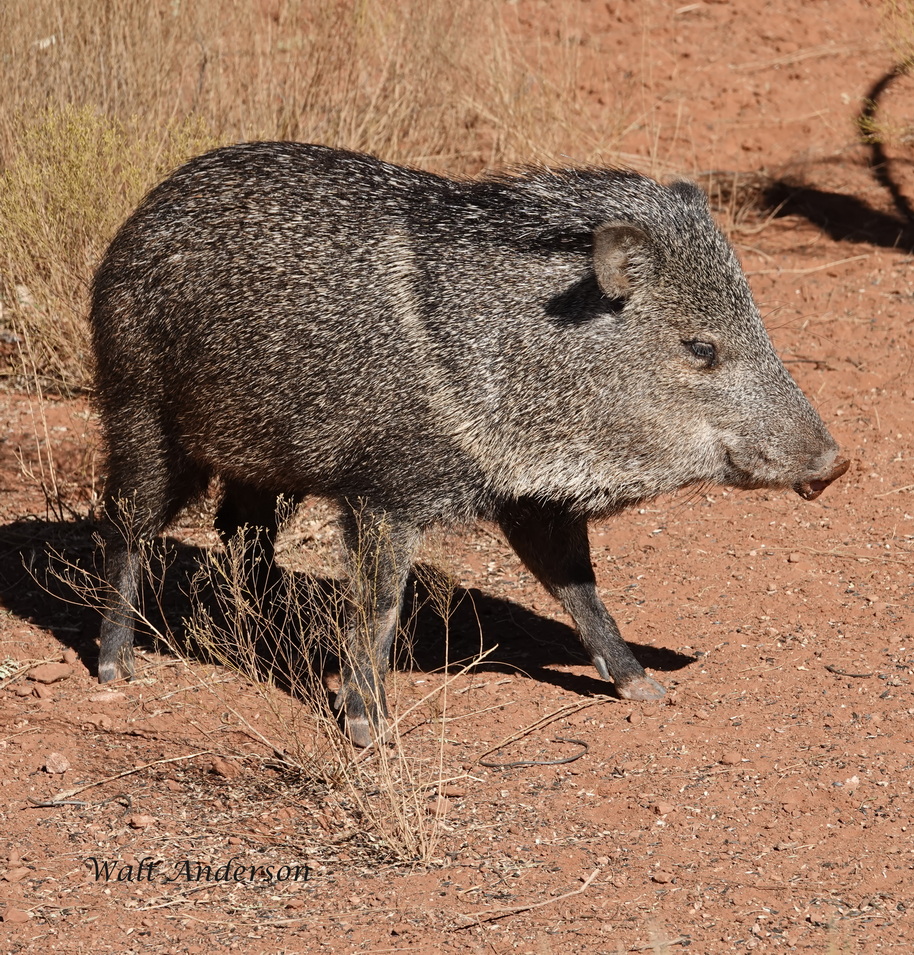
Though the bird people have done us great service by reducing ambiguity by using clear naming rules, mammal people (aren’t we all?) and other taxonomists usually don’t follow suit. I apply the same rules to ALL taxa. To me, this is a Collared Peccary, not just any old peccary that some researcher has collared. There are three species of peccary, and each deserves a proper name. That’s only proper.
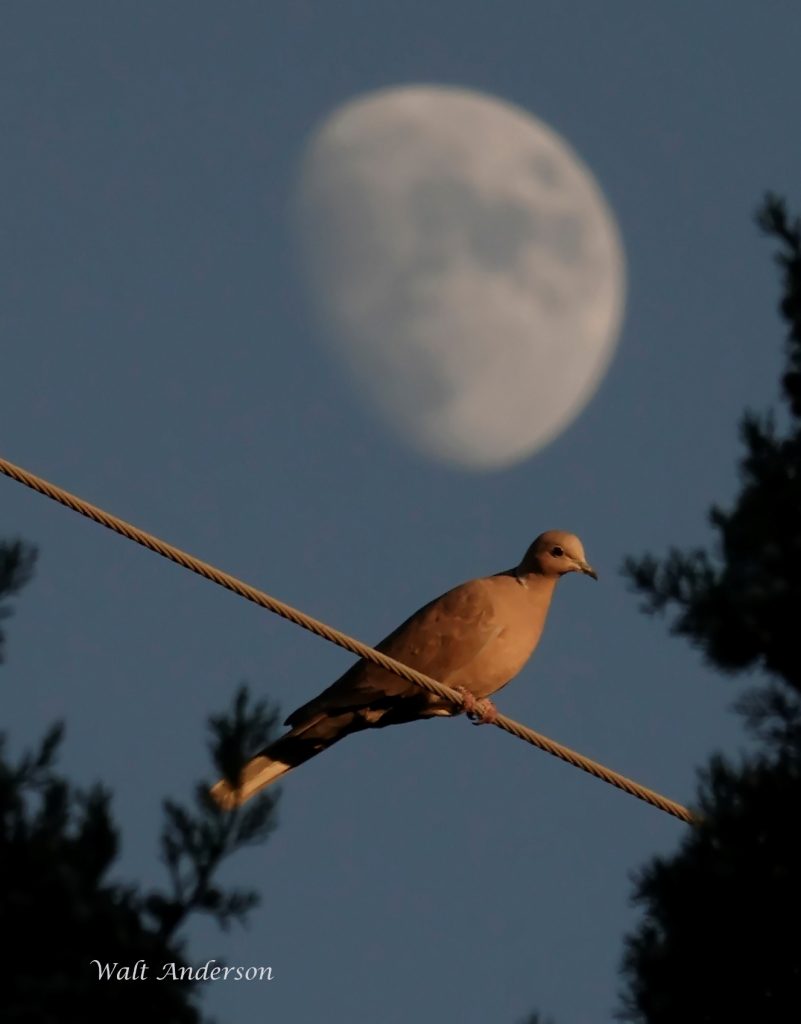
So if you awaken at dawn and hear “hoo-HOOOO-hoo” repeated incessantly, it’s probably not an owl. Most likely, it is your Asian (I mean Eurasian) Collared-Dove. Take comfort in knowing that this is no European Starling or House Sparrow, introduced species that have competed unfavorably with our native birds. It is a new neighbor that thrives in conditions we have created. In a sense, it is one of us.