Among Friends. I’ve Got the Blues, by Walt Anderson
When birders have achieved most of their goals, at least a high level of proficiency at bird identification, they often add butterflies to their most-wanted lists. “Butterflier” is a much less elegant term than birder, but it gets the point across. Butterflies and moths are in the order Lepidoptera, with professional scientists called lepidopterists. A small group of those seeking these insects consider themselves “leppers,” which I like, though verbal identification can lead to them being outcast as “lepers.”
I’ve grown to love leps, mostly the butterfly side of the large family, but I admit that it’s much more difficult than birding. I’ll get to a number of reasons why, but let’s start with size. There are no eagle- or crane-sized butterflies. Even a hummingbird is gigantic compared to many butterflies. No wonder that butterfliers often depended on swooping them up with a net to get a proper ID. Sometimes even that wasn’t enough, as to pin down some (and most of these ended up pinned), you had to look at the male genitalia with magnification.
All right, I am not a lepidopterist, and I will leave butterfly genitalia alone. However, with close-focusing binoculars and an adequate camera, I can identify the majority of the butterflies I find. For me, the name is secondary to the sheer beauty I discover when I get a good observation. Butterflies are gorgeous! So with this in mind, I want to share some of that beauty with you, focusing on a subfamily called the “blues.” These are tiny creatures, often less than an inch in diameter. With my camera, I can make them appear as big as I want, so perhaps you’ll also discover that the blues can make you happy.
#butterfly #blues #lepidoptera #waltandersonphotography #springazure #westernazure #echoazure #mutualism #ants #ceraunusblue #reakirtsblue #formicaants #marineblue #acmonblue #pygmyblue
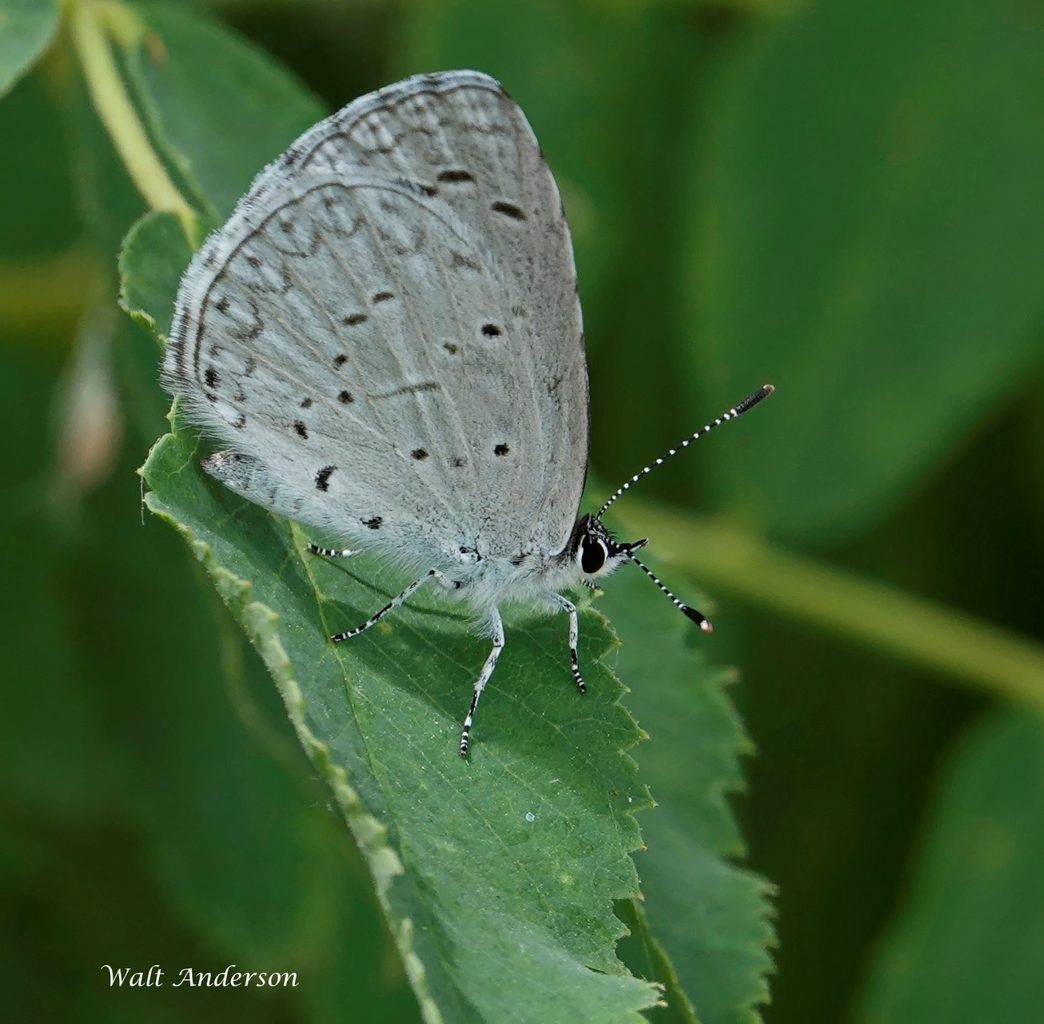
One challenge for butterfly watchers is limited amount of time each year that we can see them. As ectotherms (“cold blooded”), they rely on the temperature of the environment, which means most are not visible during the winter or even on cold or rainy days in the summer. Yes, a few species that overwinter as adults may come out on warm days, but most butterflies, including the blues, live as adults for no more than a week or two and only when the weather gets consistently better.
Butterflies are also limited by the need to find host plants for their eggs and larvae and nectar-producing flowers of the right kind. Timing is everything. No wonder some people stick to birds! However, those with patience enough can rejoice when the first Spring Azures appear for the year.
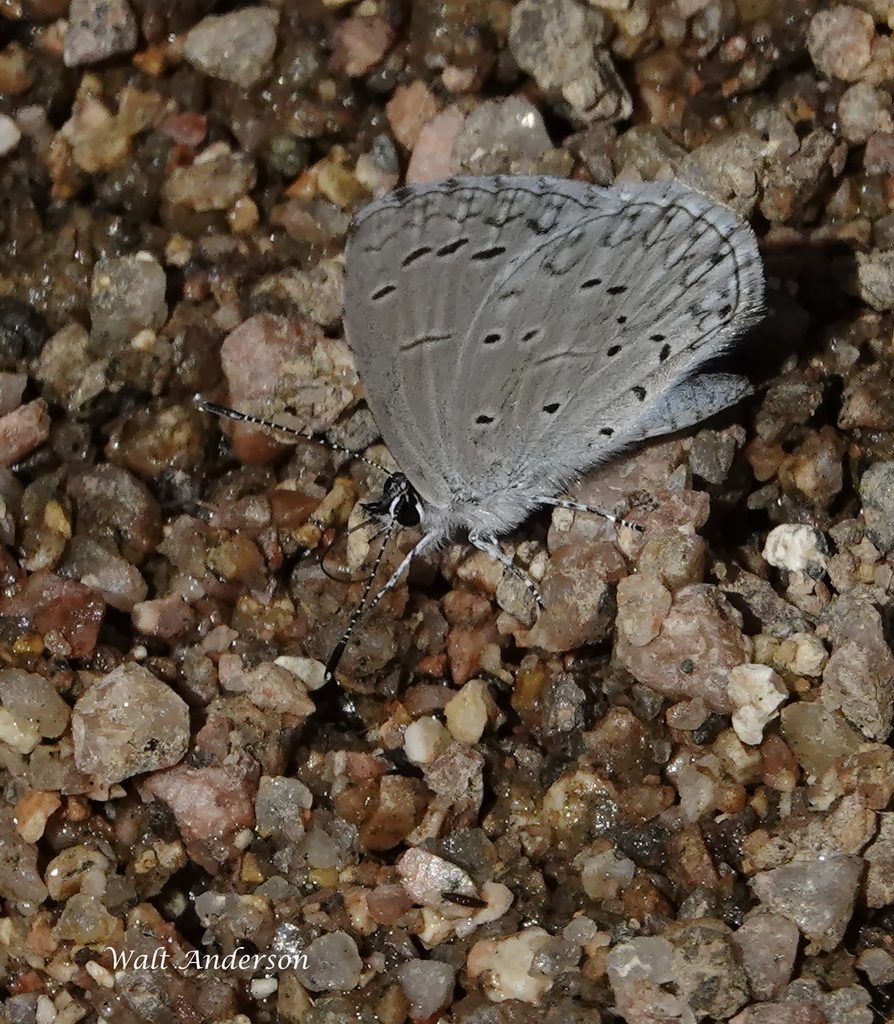
Breaking news: the Spring Azure, as shown in all my field guides except the most recent, is no more! For a long time, taxonomists referred to the “Spring Azure complex,” which was widespread across the northern hemisphere, both New World and Old. It was touted as one of the most adaptable and widespread of all butterflies. Still, there were doubters (that’s what some scientists do). Appearances can be deceiving. At last, incontrovertible truth was revealed: the name “Spring Azure” hid a number of cryptic species, so in North America, it has now been split into at least six species. With further study, there could be more.
Here in the West, this is now called the Western Azure or, perhaps more poetically, the Echo Azure. The subspecies along the west coast is Celastrina echo echo, which seems especially fitting. I think that “echo” is never redundant.
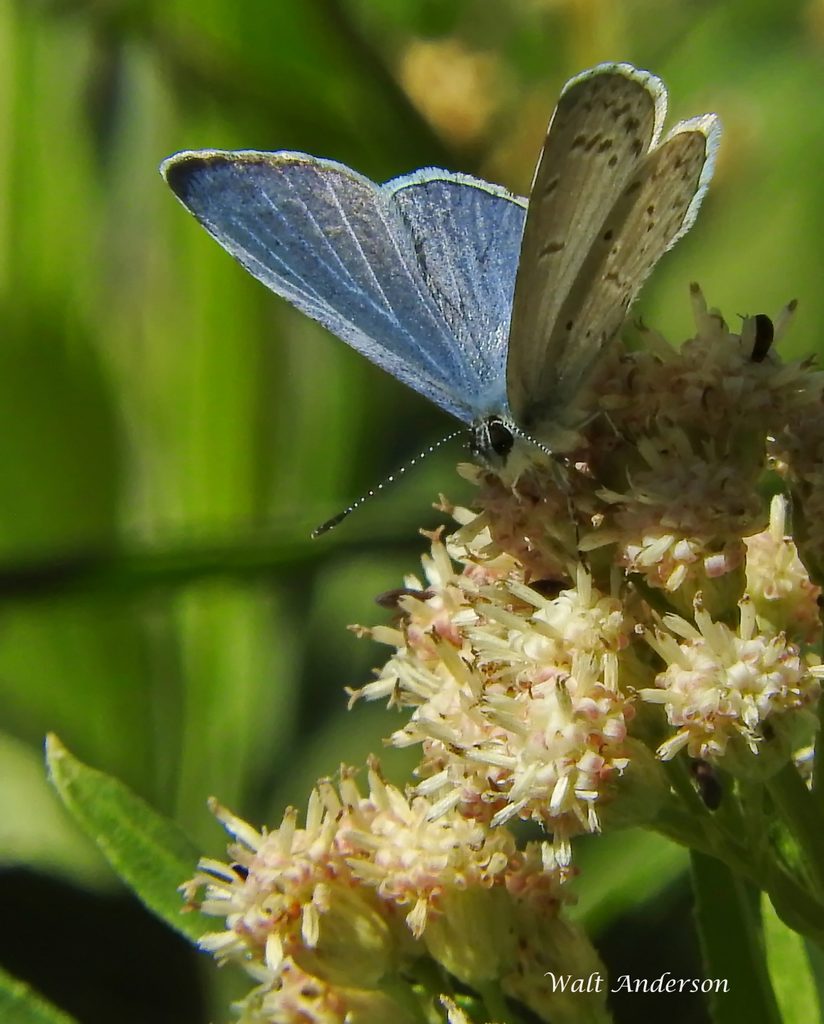
The upperside of a male Western Azure is a lovely pale blue without conspicuous spots. Females are darker, with a broader black margin to the wings. You can enjoy the flashes of blue when the insects are in flight, but they usually close their wings quickly when at rest. You are left to notice the pale underwings that appear to have some random dots and dashes (of course, they are not random, and you’ll figure that out when you compare them to similar species).
Females lay their eggs on flower buds of host plants like blackberries, ceanothus, and more. The larvae are often tended by ants, who collect honeydew in exchange for guarding against small predators or parasites. It’s clearly a protection racket, but it benefits the butterflies too.
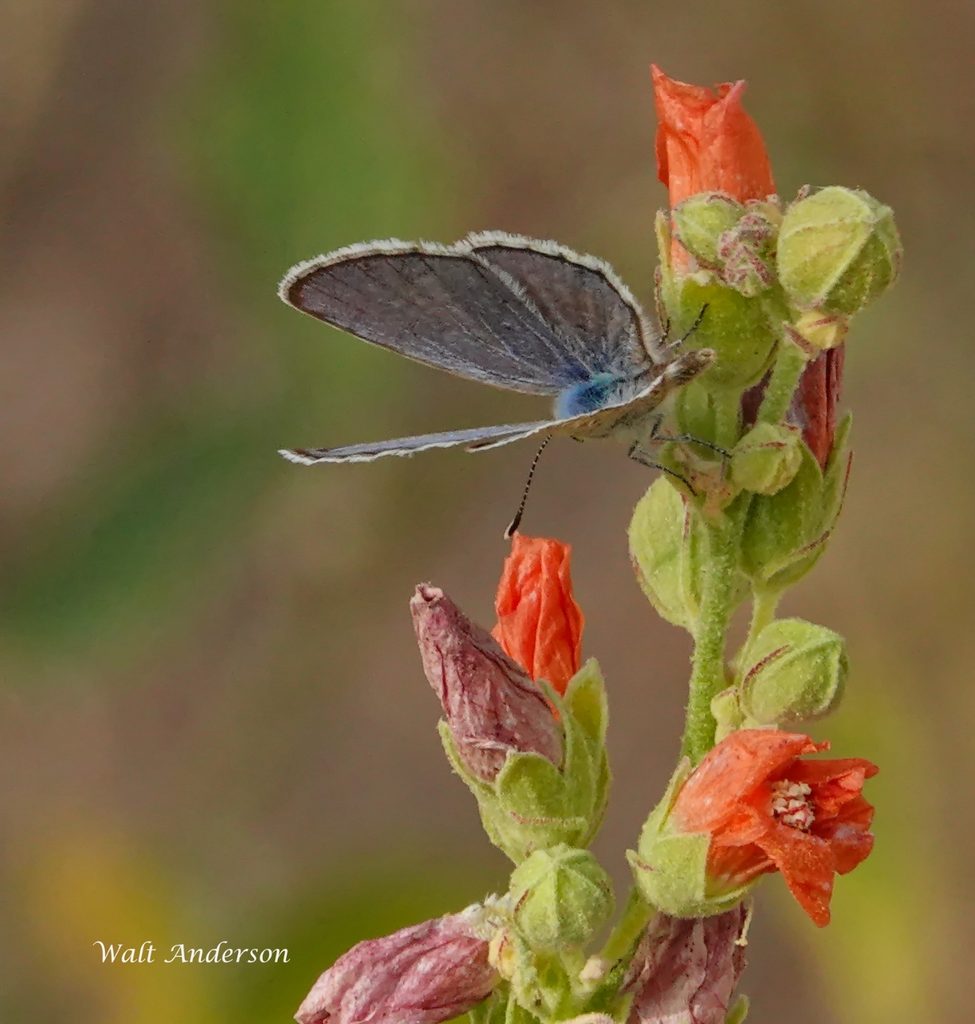
The Ceraunus Blue is found all along the southern tier of states and most of Mexico. It thrives in desert-scrub, as well as some grassland and chaparral sites. Host plants for its larvae include many legumes, like mesquite, locoweed, and alfalfa. It’s tiny and easy to miss; the bud of this globemallow is about the same size. In fact, sometimes I discover miniscule butterflies like this only because I am focusing on a flower for a photo. It reminds me to slow down and pay more attention to the little things.
The upper side is purplish blue, darker on females. In general, only Blue males are true blue, and that blue is a structural color, not a pigment. “Ceraunus” refers either to thunder or to a precious stone like onyx.
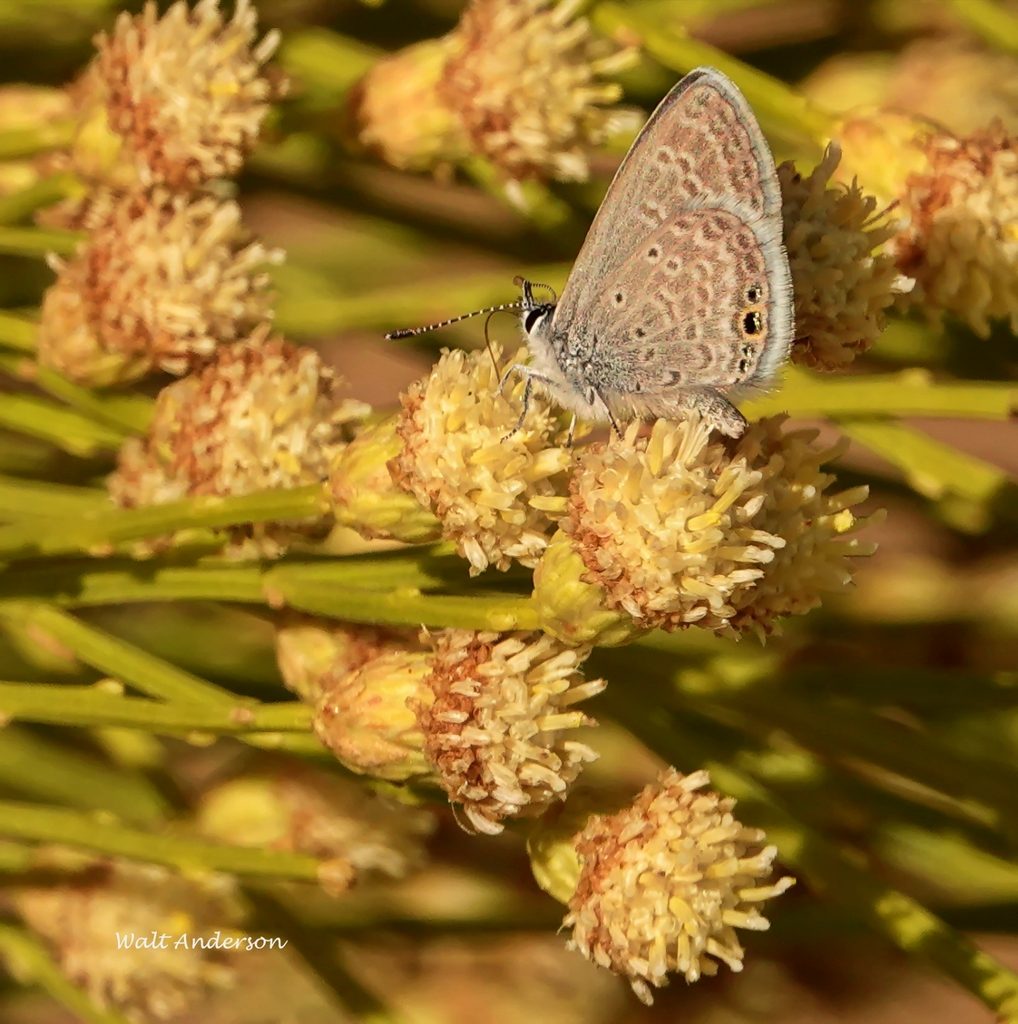
The underside is grayish brown with this particular pattern of spots (easier to see than to explain). The eyespots at the trailing edge of the lower wing may trick naïve birds to attack the wrong end of the body, and some studies have shown more bird pecks there than at the real head. That effect is more pronounced (and presumably more effective) in the related hairstreaks, which usually have little wing extensions that appear like antennae.
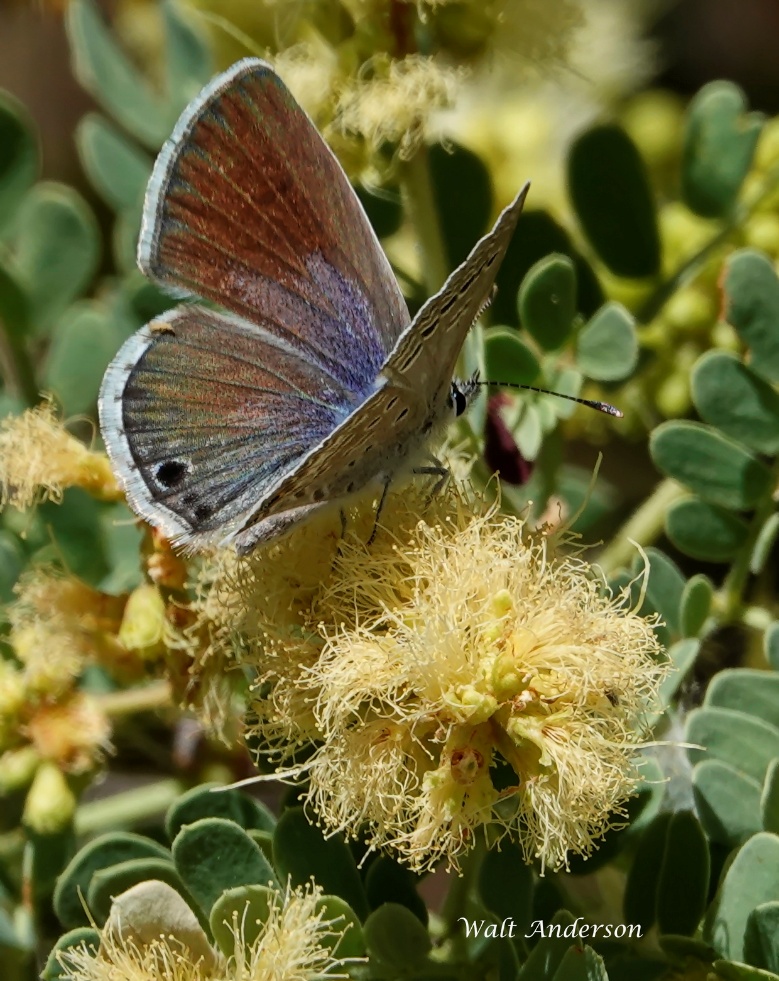
Blue on the female Reakirt’s Blue is confined to near the body, with purples and coppers extending laterally. She’s simply lovely to behold, though the insect is so tiny that you have to work to get a good look. The species prefers legumes for both larval and adult uses. Like some other blues, this species has a mutualistic relationship with certain ants, especially the genus Formica (you’ll never find these as countertop material, however). They pupate inside ant nests, keeping that relatively helpless life stage out of view of hungry birds or parasitic insects.
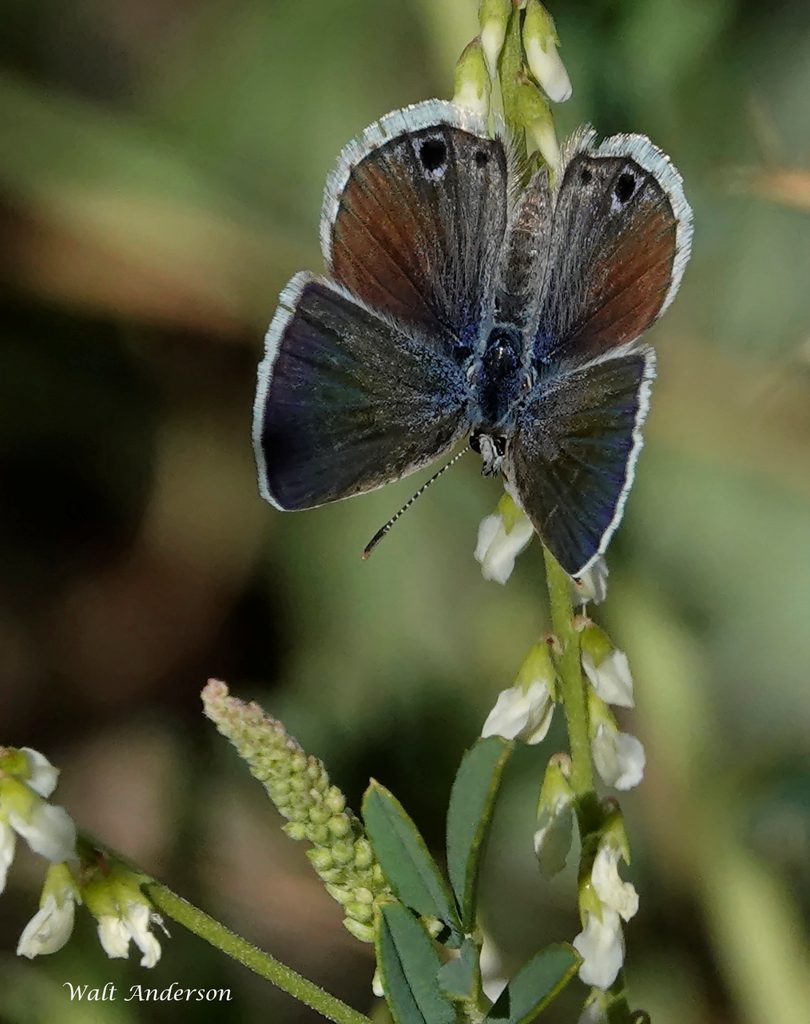
I found this one on a white sweetclover, a legume for sure. Too often, I don’t see these beauties if I am walking at a normal pace. Butterflies, with their compound eyes made up of hundreds of tiny receptors (ommatidia), are very sensitive to movement. Once I have startled one, I try following its erratic flight, hoping to get a photo, but a disturbed blue is likely to lead me on a wild lep chase. I keep thinking it will land, but its tiny brain seems smarter than my big one. I am better off moving slowly and examining plants carefully to find one that has not yet taken flight.
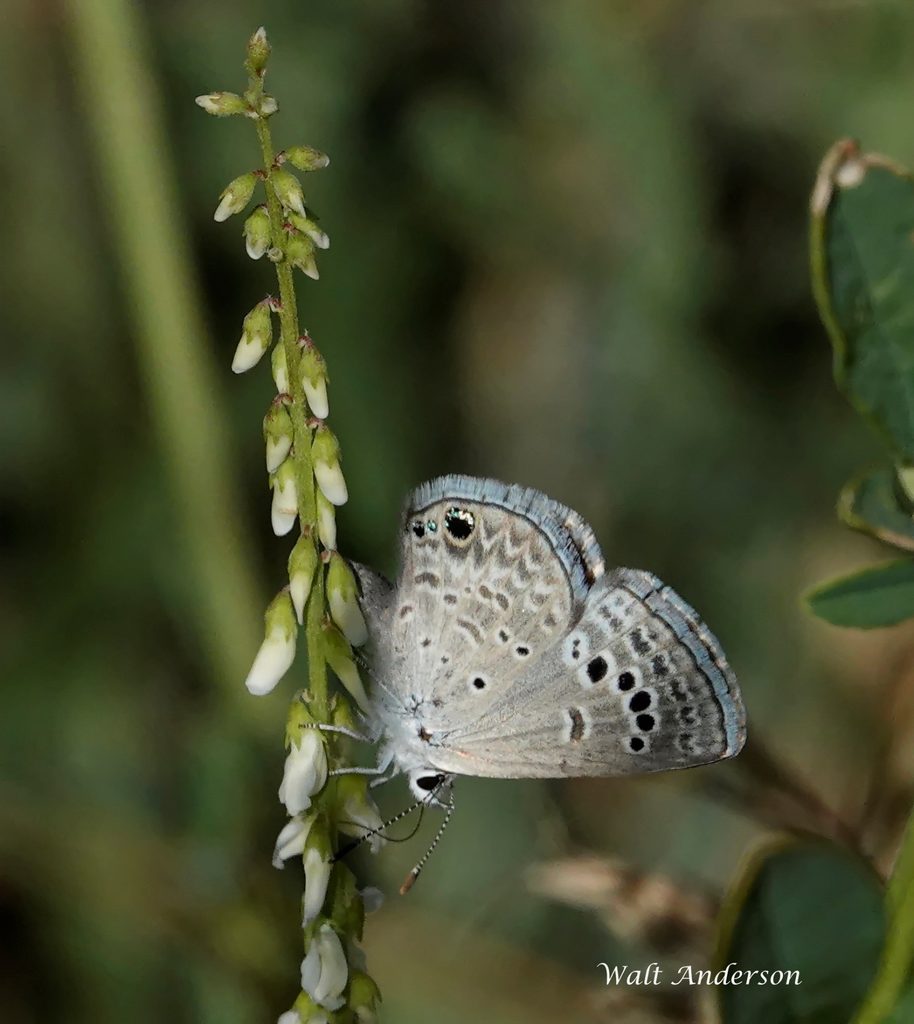
The Reakirt’s Blues are more boldly patterned below with an arc of black spots encircled in white. That little bit of glitter on the eyespot to the left is called a scintilla, meaning a tiny spark.
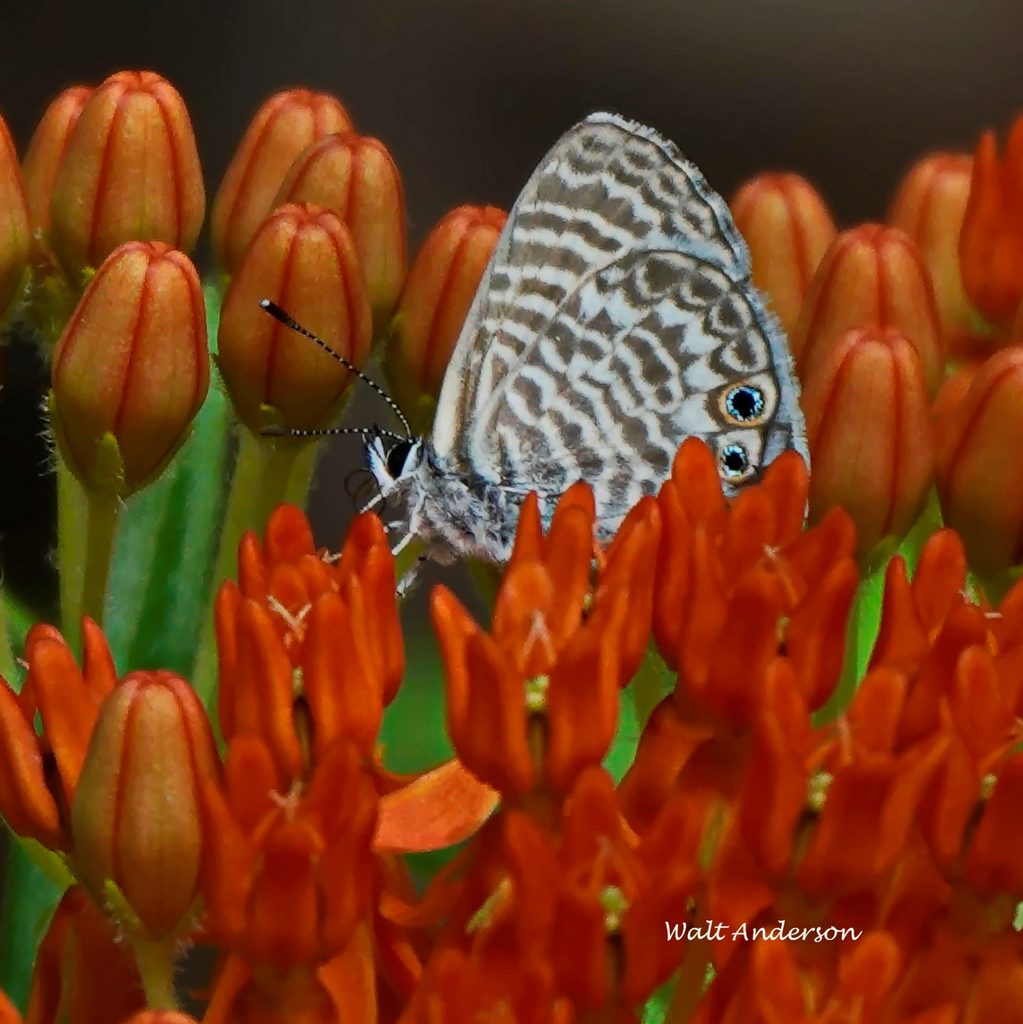
Perhaps easiest to identify with the naked eye is the Marine Blue with its extensive dark stripes bordered with white and its striking scintillae. This beauty is on a milkweed appropriately named Butterflyweed.
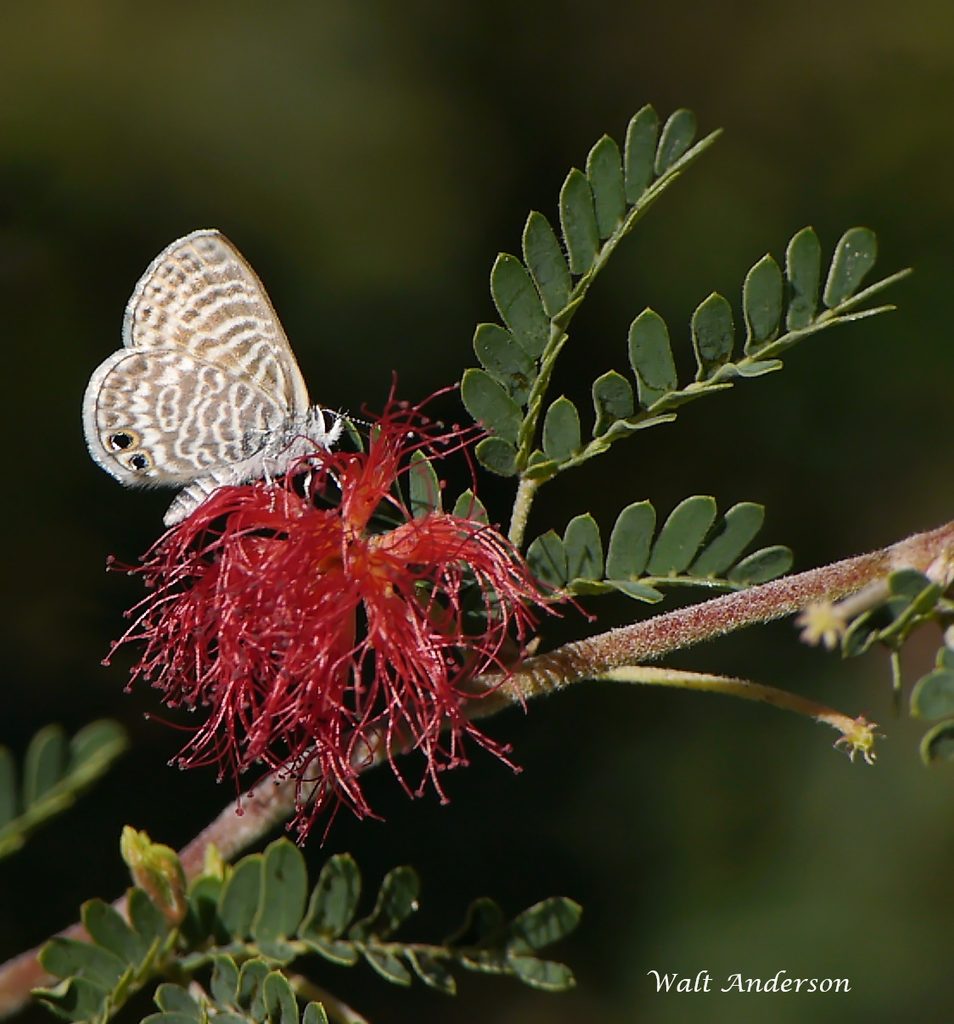
The Marine Blue uses a variety of legumes (e.g., mesquite, catclaw, false indigo) to oviposit its eggs; the larvae feed on buds and flowers but not leaves. “Marine” apparently refers to the blue upperside of the male’s wings, though I suppose you could imagine those stripes as successive waves. Its primary range is the US Southwest and Mexico, where it occupies a variety of ecosystems.
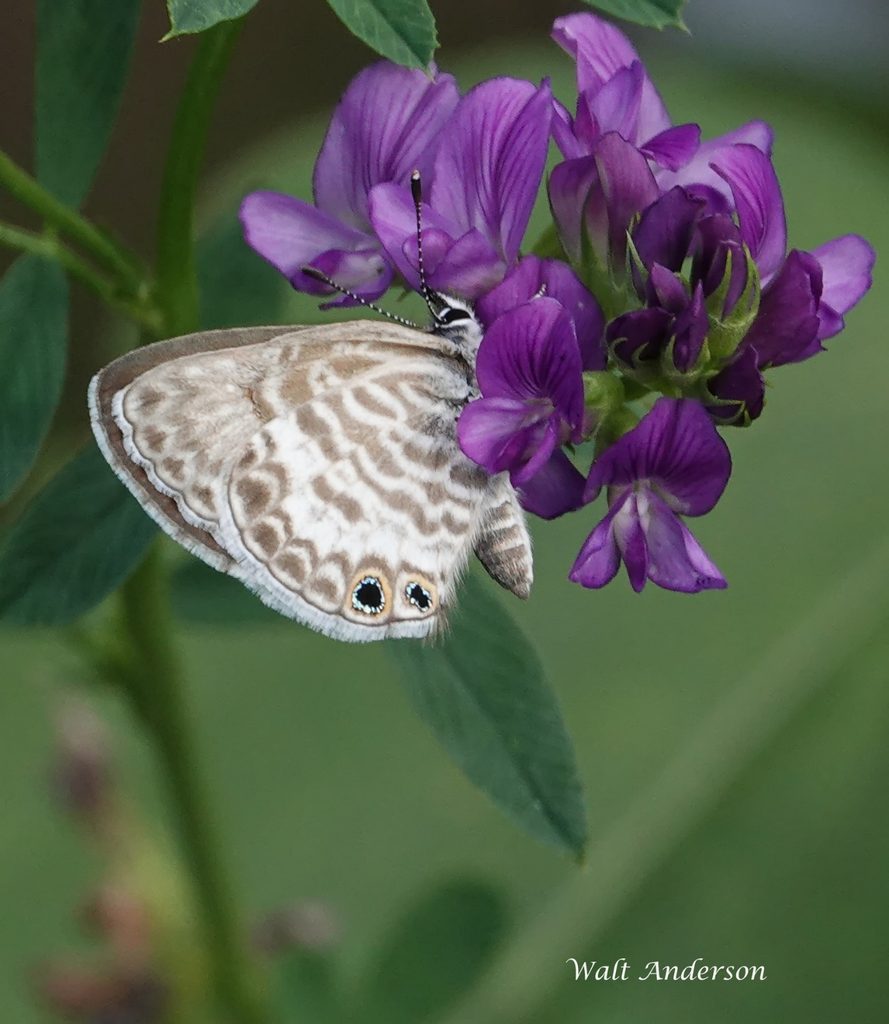
Like a number of butterflies, the Marine Blue can have several generations a year. Individuals, even though they live about a week, often wander to the north for the next generation. A range map for this species would show that Mexico, southeast California, southern Arizona, and southwest Texas can have up to three broods per year. A narrow band to the north may support two broods, while just north of that, the butterflies breed later and have a single brood. The range map may show dots scattered even farther to the north, including Oregon, Montana, Wisconsin, New York, and Massachusetts. How can a tiny butterfly that lives for a week get so far? Hey, perhaps as hitchhikers in truckloads of alfalfa.
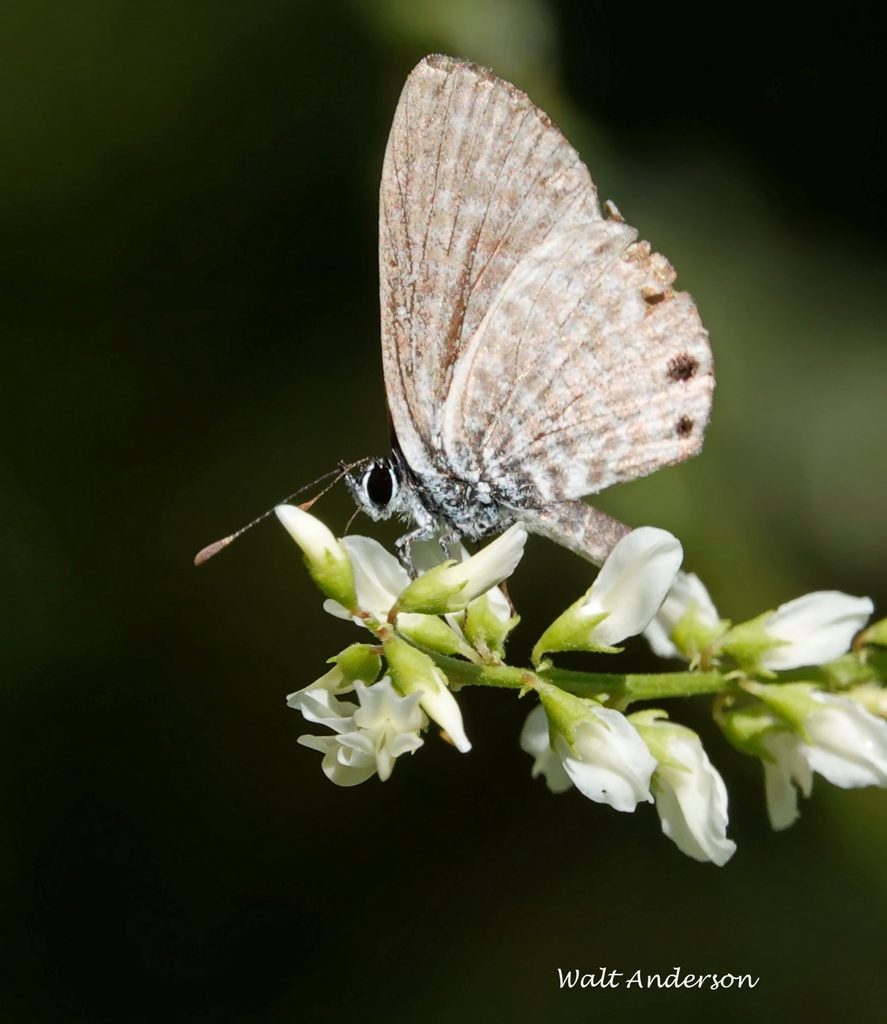
Just when you think you’ve gotten several blues figured out, you see something obscure like this. It’s an elderly Marine Blue, perhaps seven or eight days old. Yup, a geriatric butterfly, perhaps enjoying its last supper. If she’s a female, she would have accomplisher her mission as an adult. She would have used her exceptional set of senses to discover an appropriate species and the right part of the plant on which to lay her eggs. She has sense organs all over her body. When she lands on a possible host plant, she will create a tiny slit in its cuticle in order to taste it with her leg sensors. If it appears to have high nutritional value, she will lay an egg right there; otherwise, she will move on for a better host plant. It pays to be picky, for a larva on the wrong plant will fail to thrive or even die.
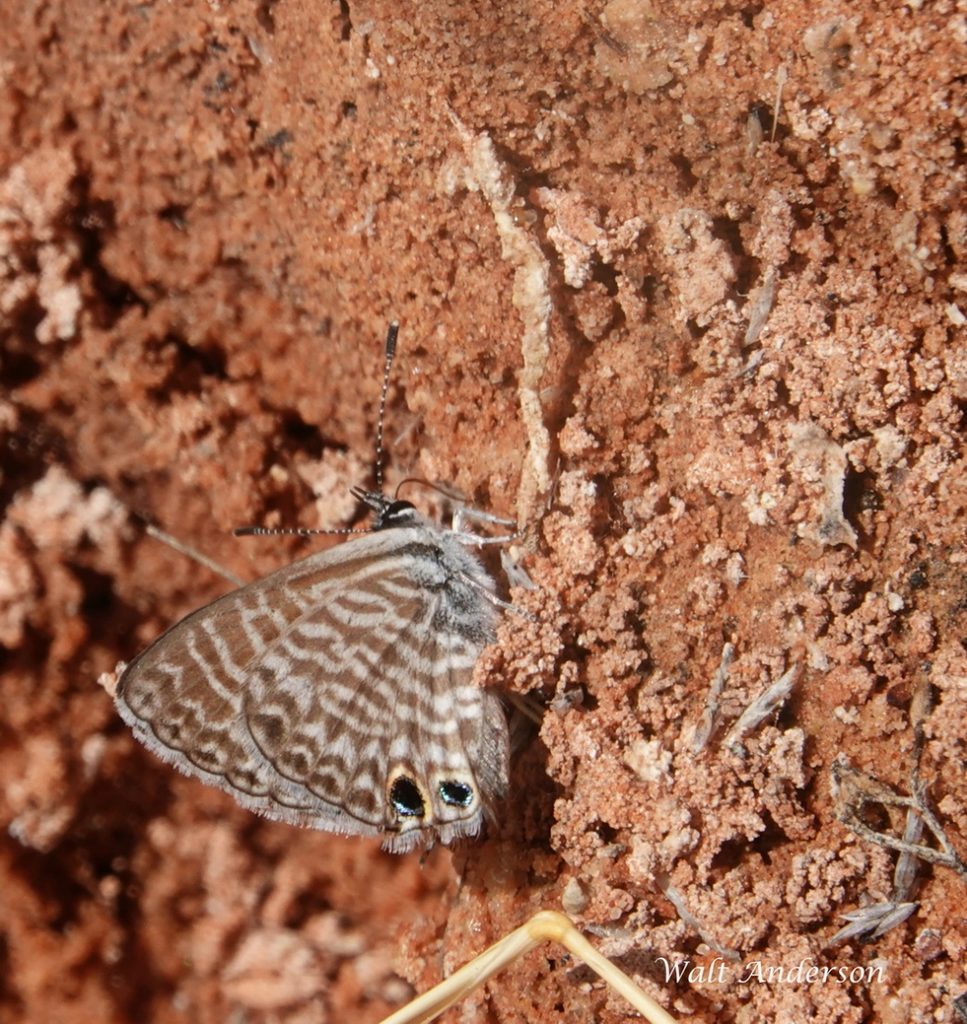
While adults may harvest a little nectar, a bit of energy to help get through that brief life, they don’t grow at all. All their growth occurred as larvae or caterpillars, a time in which they molt out of an exoskeleton (the only way they can grow) about four times. Those stages are referred to as instars. In essence, butterflies have four lives: a plump little egg, a voracious neuter caterpillar that is an eating machine, a quiescent pupa or chrysalis during which time the body is reorganizing itself and creating wings, and a short-lived adult preoccupied with sex. Each stage has specific requirements that need to be met. Only the adult has any significant mobility, and in the case of the blues, that’s not terribly far (the strongly migratory Monarch is one of the more exceptional travelers).
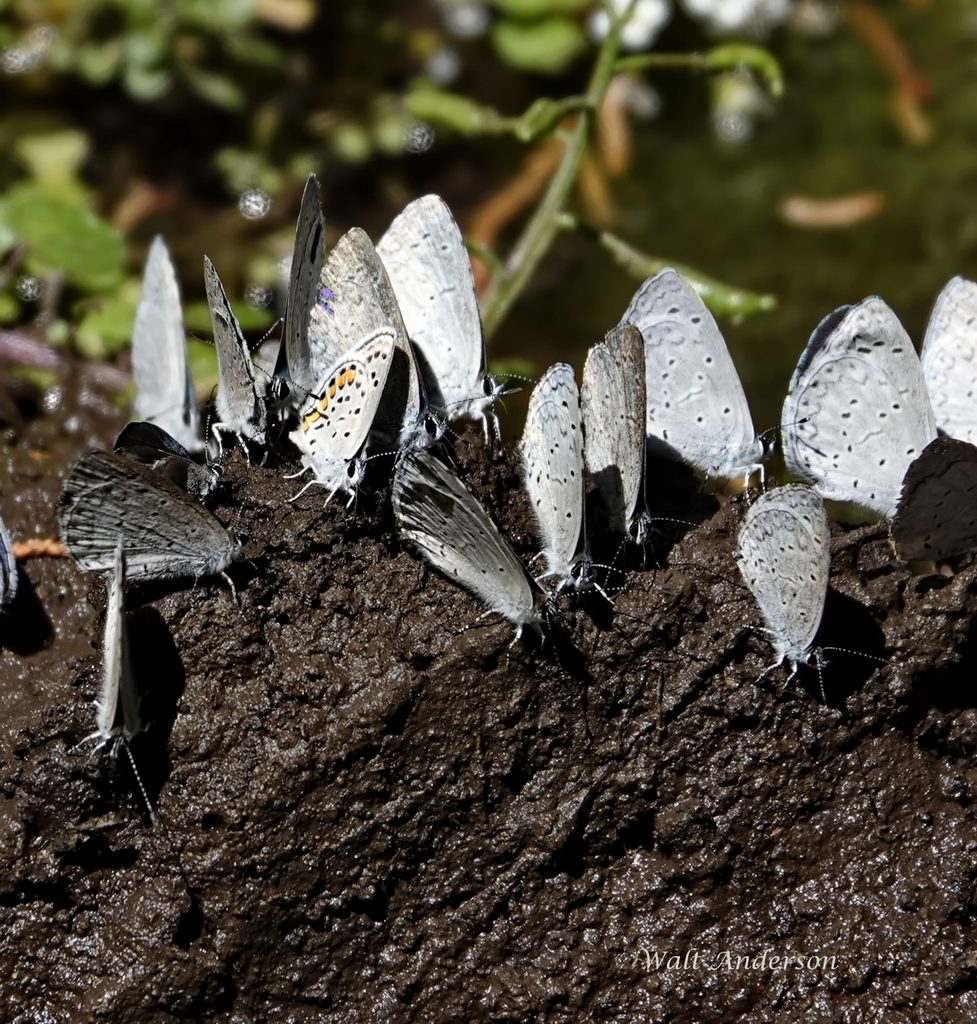
Females tend to feed as larvae a day or two longer than do the males, and when they metamorphose into adults, they are ready to mate right away. Males often gravitate to sources of nutrients (e.g., scat, urine, decomposing carcasses, your sweat) to develop well-stocked spermatophores to offer to the females when they appear. Puddling parties may have several species. Males have several strategies for finding females, often approaching anything fluttering. Their eyesight is not sharp except for detecting movement, but when they get close, an exchange of pheromones establishes appropriate recognition.
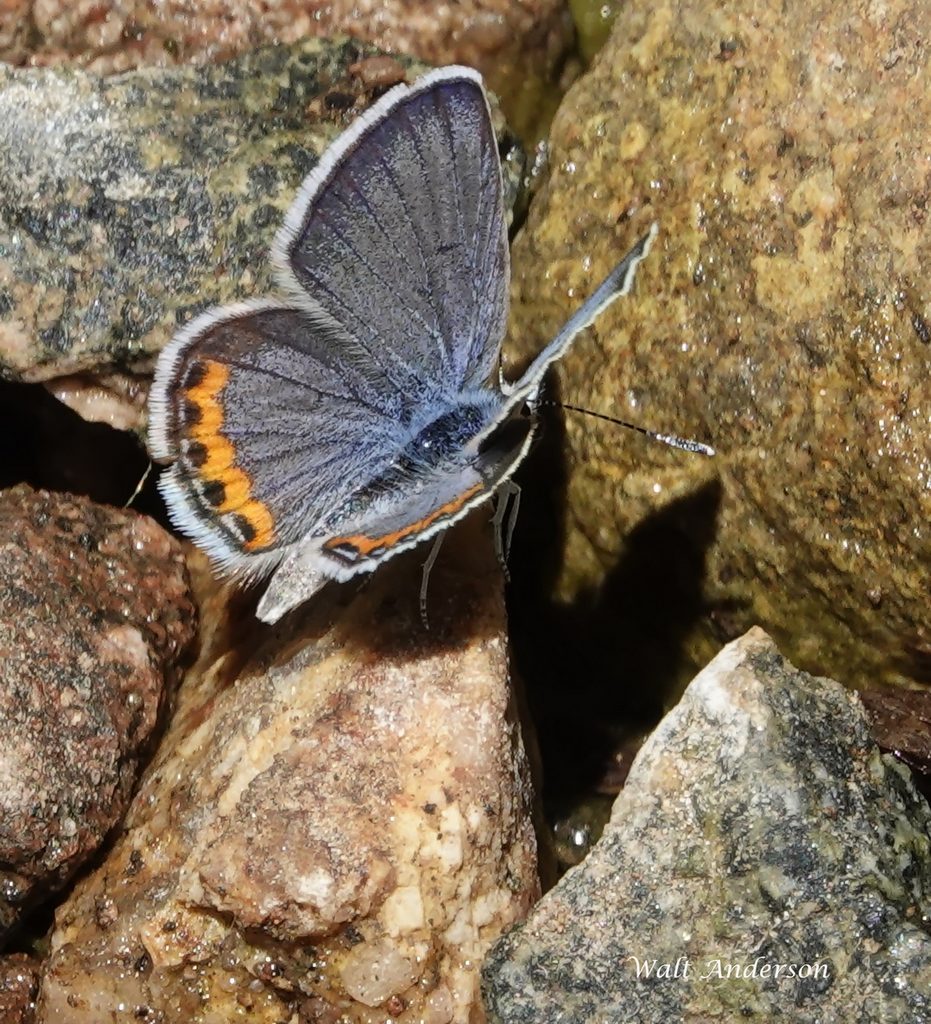
This male Acmon Blue is sipping moisture at a spring. He can sense salts, amino acids, and other chemicals that will enhance his quality as a male and hence as a mate.
Those crescent-shaped orange marks on the hindwing are called “lunules,” because of resemblance to the new moon.
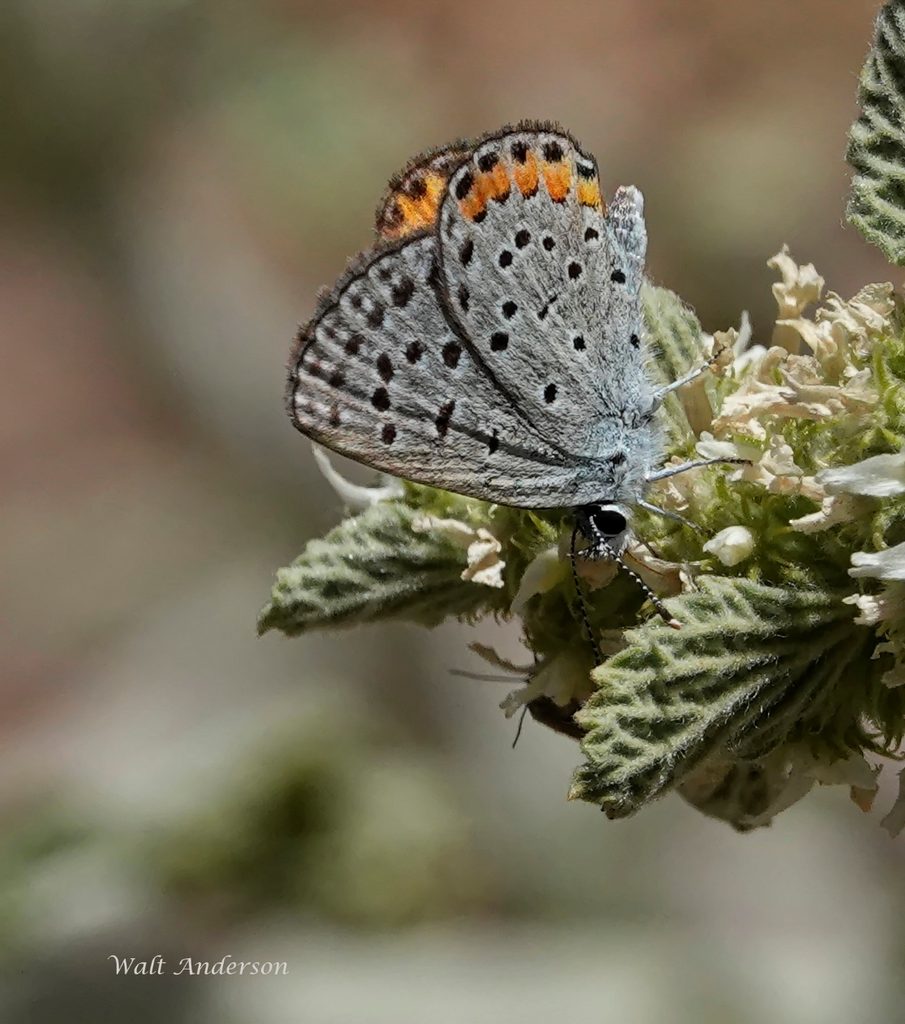
The Acmon Blue has orange spots both above and below the wing, making it one of the more dramatic of the blues.
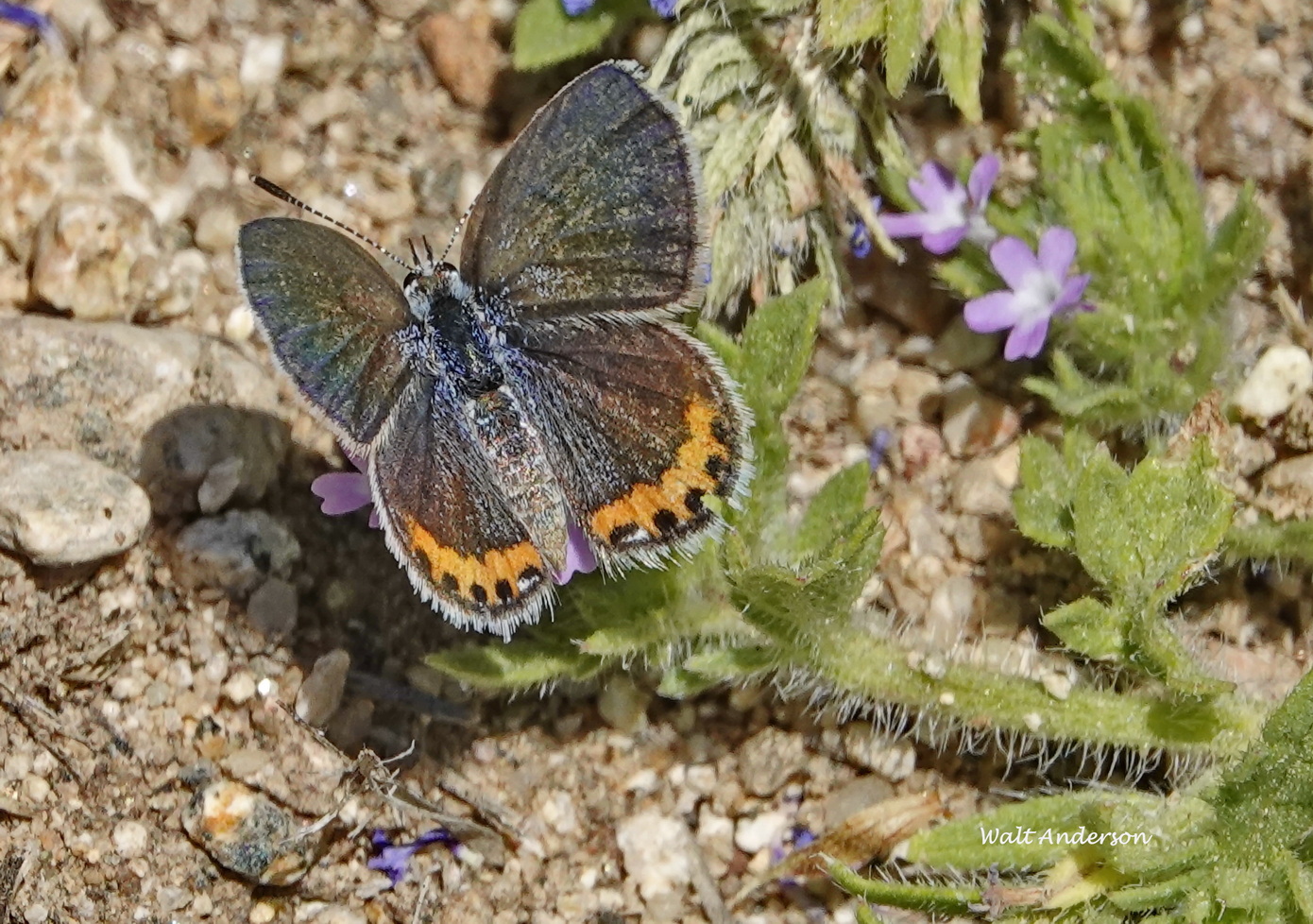
The Acmon is another of the blues that seeks out legumes for host plants, though buckwheats also suffice. It too is symbiotic with ants, with its larvae overwintering inside the ant nests. Ants have hard exoskeletons that help reduce risk of dehydration, but bodily secretions also help create a colony odor that the ants recognize as “family.” It’s believed that the larval blues may have a similar secretion that mimics that of the colony and prevents aggressive rejection.
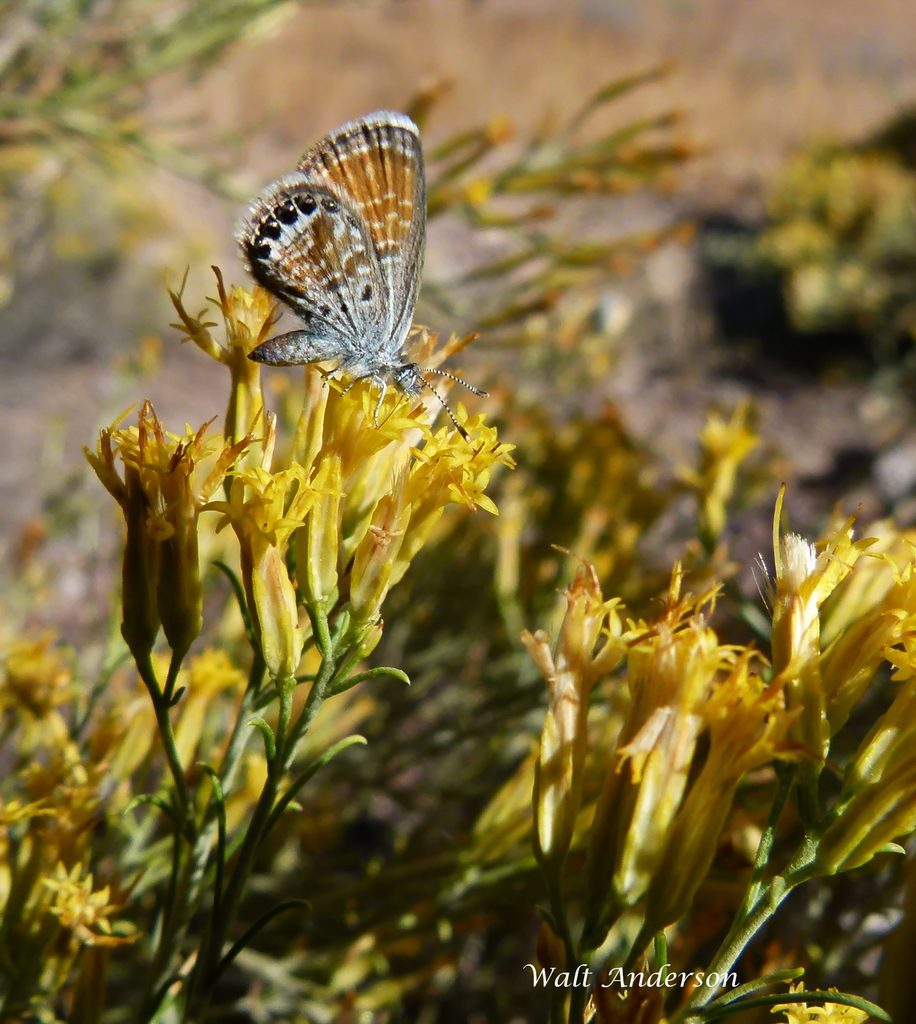
The final example I want to share with you is the Western Pygmy Blue (yes, there is also an eastern species, but telling them apart is very difficult except by location!). The Pygmy Blues are the smallest butterflies in North America. They are “blue” by relationship, not by actual color. Those marginal black spots have a hint of silver iridescence. This tiny butterfly tends to occur in alkaline areas where saltbush and other members of the goosefoot family occur.
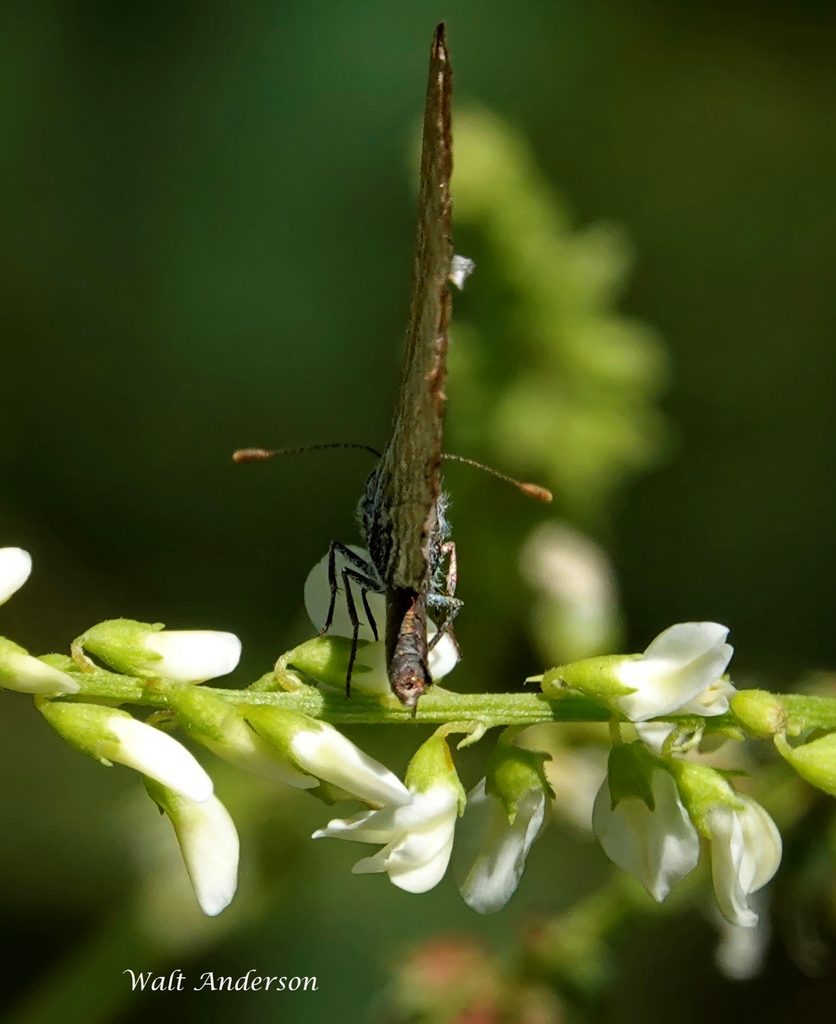
A challenge to the photographer is to catch the butterfly with its broad side toward you. This kind of view doesn’t help with identification!
If you thought a butterfly was two-dimensional (as this photo might suggest), I hope that this essay has helped you see just how complex and interesting these tiny insects are.
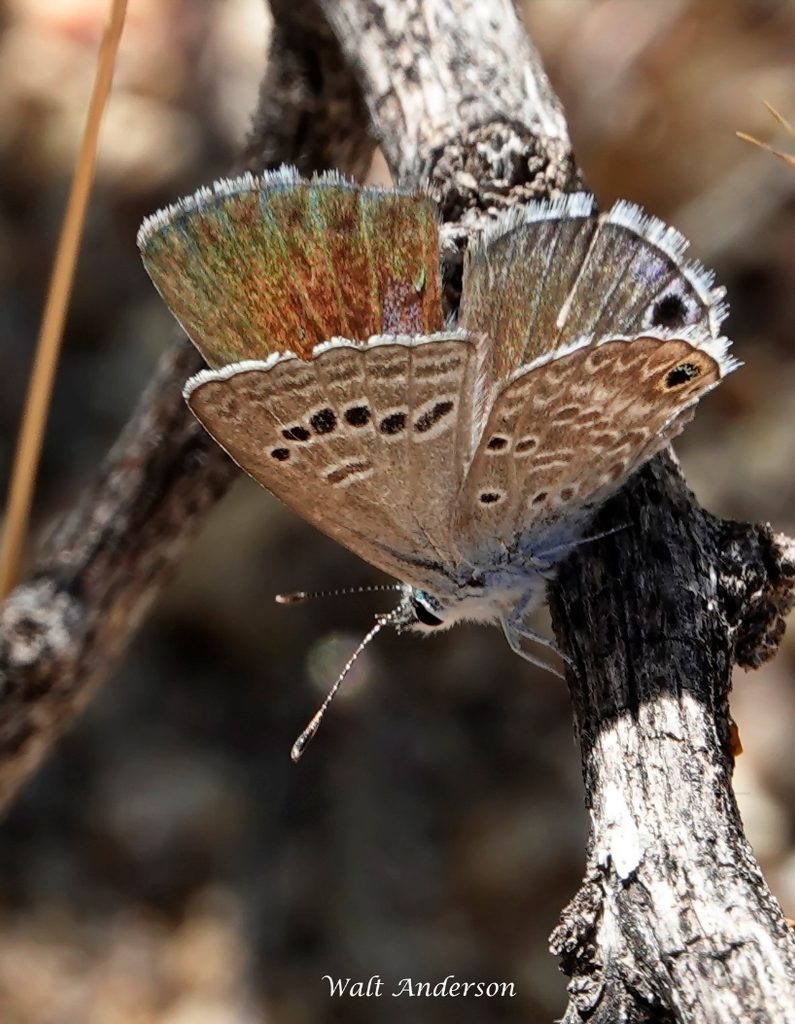
While butterflies in general are more difficult to observe than birds (you can’t even locate them by vocalization!), they are certainly worth the effort. Blues may be tiny, but they are often brilliant. Their life stories are complex and interesting, with much left to learn.
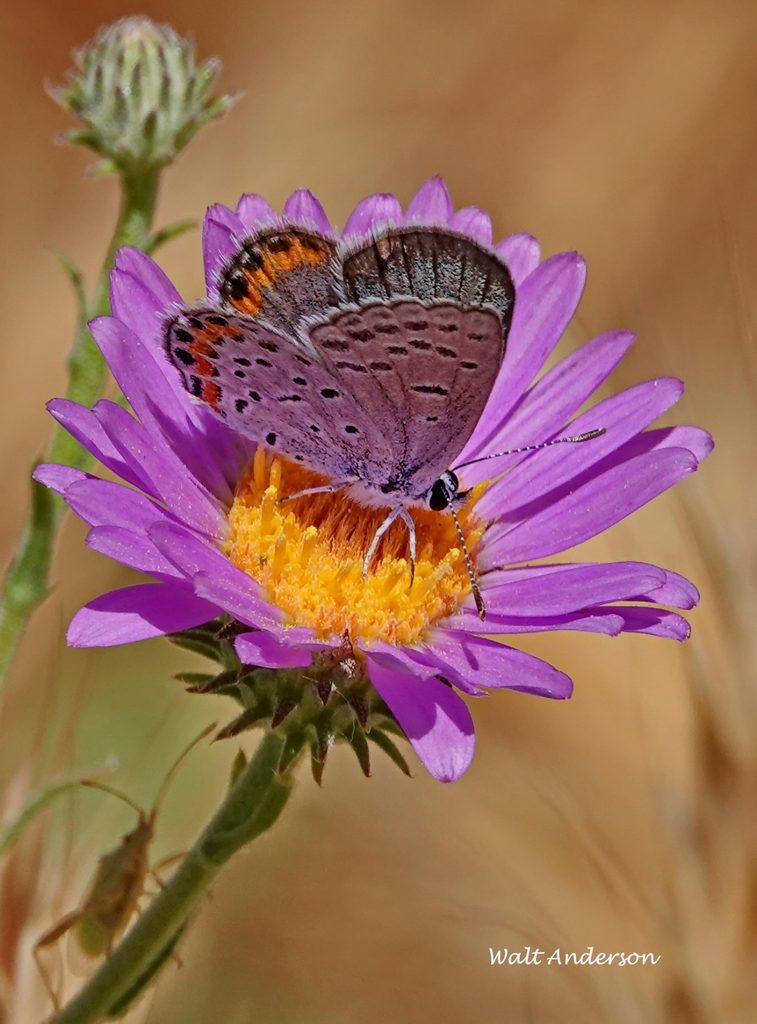
The world is filled with beauty. There are stories wherever we look. At first glance, this is a gorgeous butterfly on a stunning flower. But if you look down to lower left (the sinister side), you can see an assassin bug approaching. This is a story that I missed in real time, but my photo revealed it. These dramas and incredible beauty are right there in our neighborhoods; we don’t have to travel the world to find them. It just requires using all our senses (and in some cases, aids like binoculars or a camera) to find them. Happy hunting!