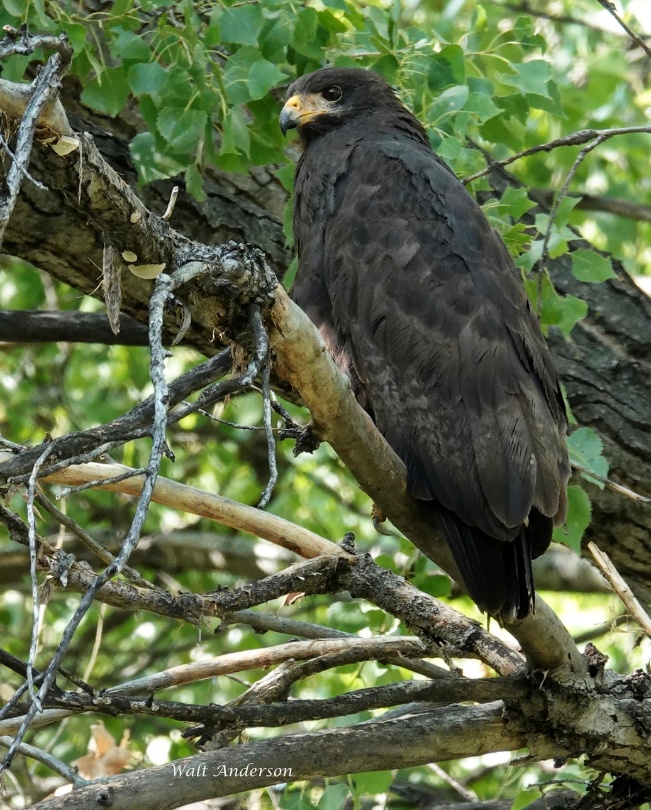
Among Friends: The Uncommon Black Hawk, by Walt Anderson
When it comes to wildlife populations, the word “common” relegates a species to the “least concern” category. Given that, the Common Black Hawk is grossly misnamed. This magnificent raptor is rare and local in the US, found primarily in streamside habitats, especially in drainages of the Mogollon Rim in central Arizona. Yes, it’s more common in Mexico and Central America to northern South America, where it often overlaps with a slightly larger cousin, the Great Black Hawk (don’t think for a minute that “great” means it’s better than ours!). That should not diminish how special this bird is in Arizona. Sometimes taxonomists are not very creative in naming, and common (there’s that word again) names can be quite misleading. In 1990, author Paul Johnsgard wrote that prospects for this species in the United States were “bleak.”
Arizona is believed to have but 160 – 180 nesting pairs. That’s a drop in the bucket, and it reflects how little suitable habitat remains in the state. However, raptor surveys near Tubac each year have suggested growing numbers of migrants. Some have showed up at Buenos Aires NWR at headquarters, the Arivaca Creek trailhead, Honnas property, and Arivaca Cienega. There is reason for some cautious optimism. I hope that growing awareness of this unique species and its habitat needs may result in some special protection. Join me to learn more and then to become an advocate for an uncommon, yet important, raptor.
#blackhawk #commonblackhawk #mogollonrim #buteogallus #riparian #granitecreek #chicagoblackhawks #chiefblackhawk #santacruzriver #tubac #verderiver #crayfish #watsonwoods #willowlake #zonetailedhawk #importantbirdarea
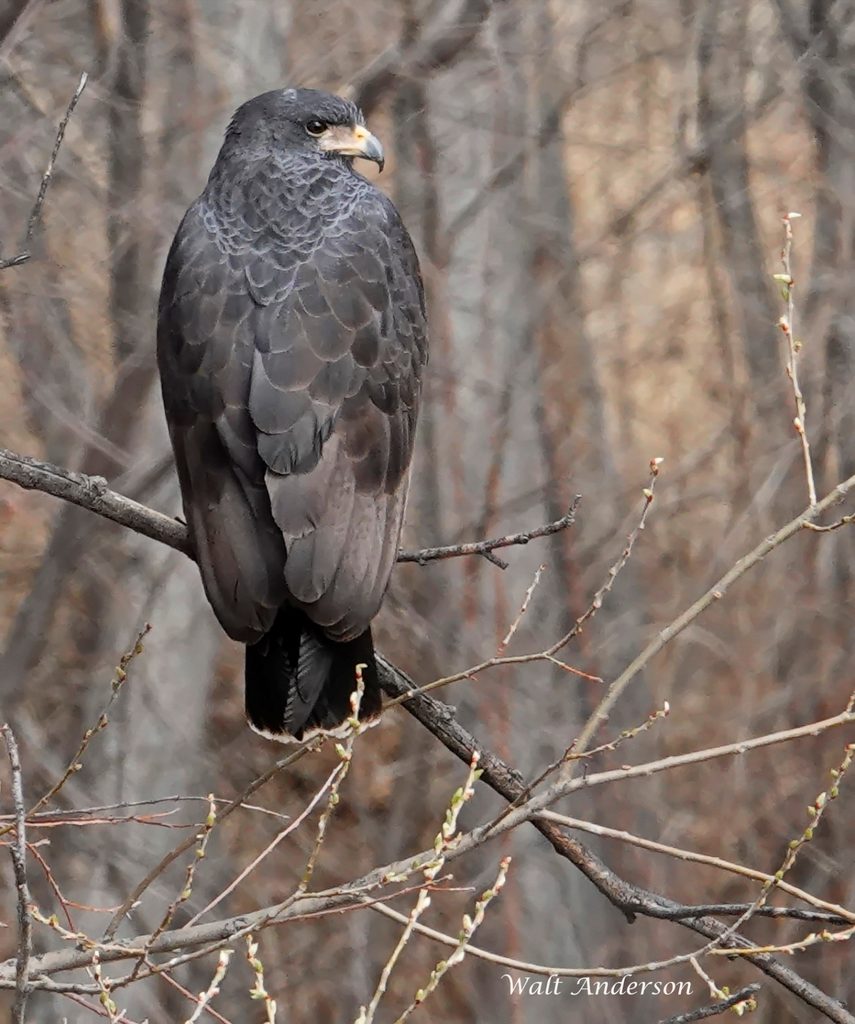
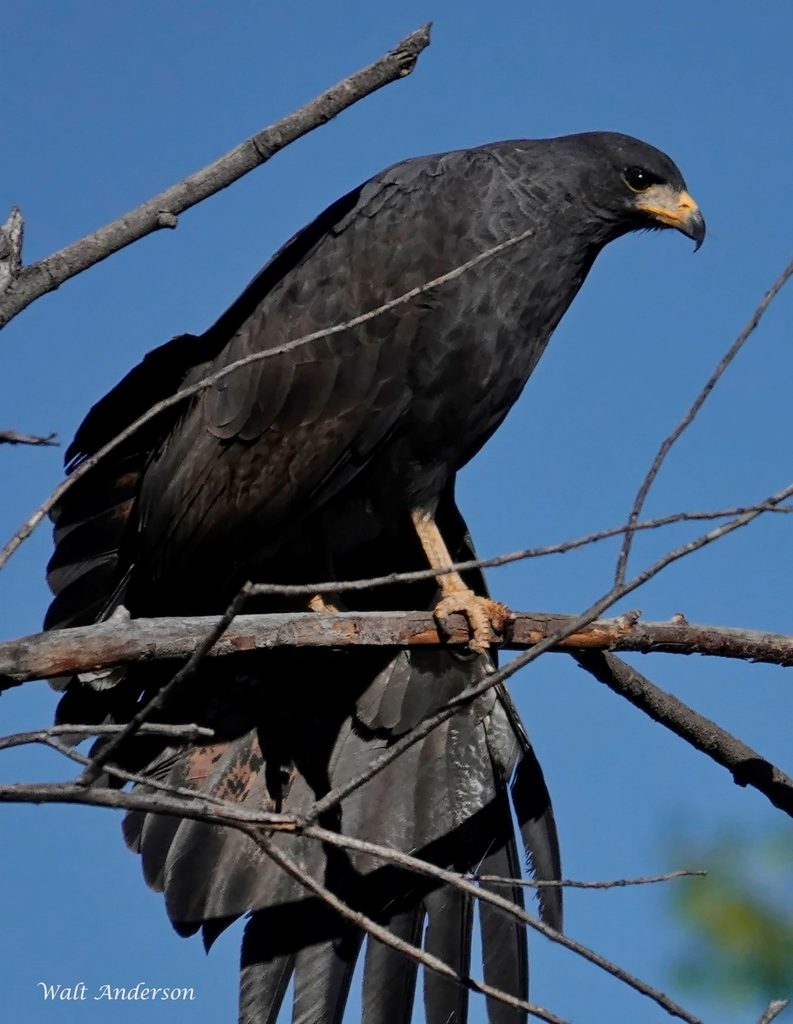
The scientific name of the Common Black Hawk is Buteogallus anthracinus. “Buteo” is a generic term for “hawk,” and “gallus” means “chicken,” so you might thing this is a chicken-hawk” in a pejorative sense, but it’s believed that the name came from the bird’s long legs resembling those of a chicken. Some might have a bone to pick about that. The word “anthracinus” refers to “coal,” which we think of as black, but notice the subtle gradations of frosty gray and warm brown that make this bird quite elegant to behold.
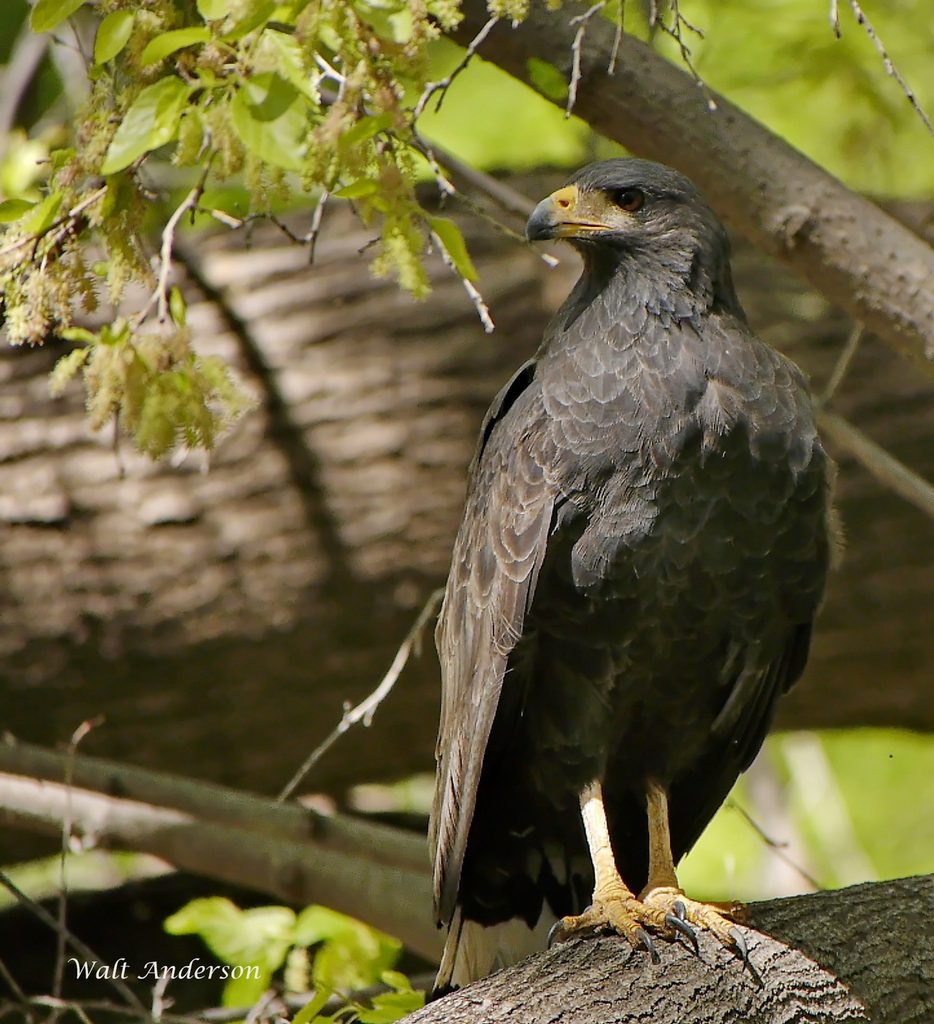
It’s a powerful, stocky raptor with broad wings and a short tail. It’s unmistakable in flight because of that distinctive shape (some have referred to it as a “flying umbrella”). In Arizona, it’s considered a riparian obligate, meaning that it’s restricted to the mature gallery forests of cottonwood, sycamore, alder, ash, and other trees that fringe waterways. It’s a sit-and-wait predator, often perching above a shallow stream, where it can dive upon aquatic prey like fish, frogs, invertebrates, or garter snakes. More on that later.
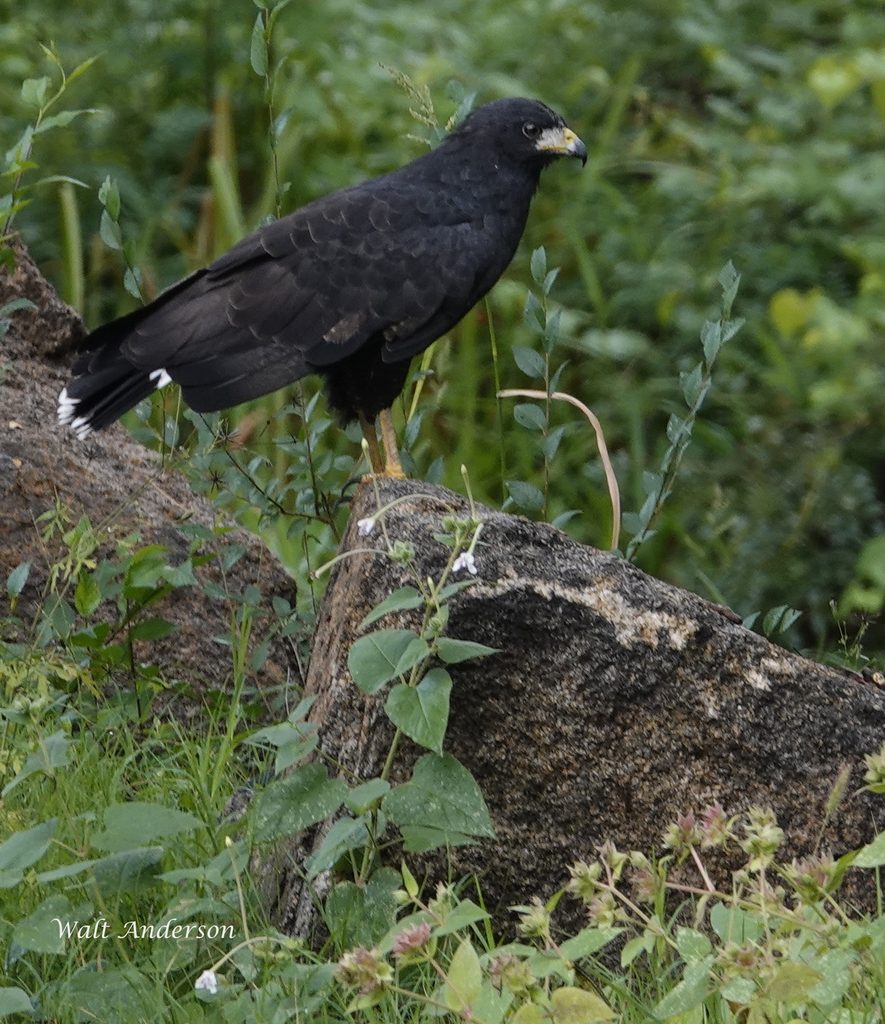
As you go south in its more tropical range, you will find it using a much broader spectrum of wetlands, including coastal mangroves, estuaries, marshes, lakeshores, and lagoons. Land crabs are a major component of its diet in parts of its tropical range. Honestly, its common name would be better as the “Aquatic Black Hawk” rather than “Common.” For the rest of this essay, I will simply call it Black Hawk.
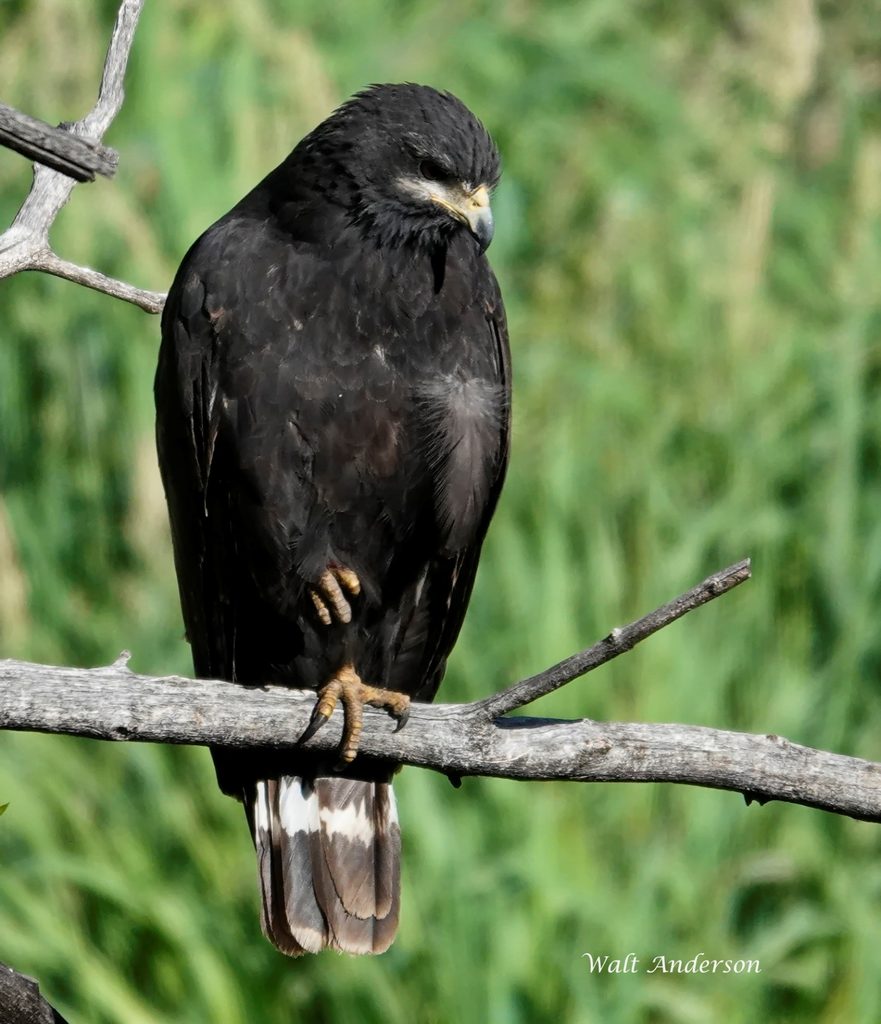
While the birds can be very excitable around their nests, when they are hunting, they focus. I was guiding a small group along Granite Creek in Prescott, and we were very close to this bird, who simply ignored us. One other field mark you can see here is the broad white band in the middle of the tail, along with a narrow white fringe at its tip. The similar Zone-tailed Hawk has multiple white bands (“zones”) on its narrower, longer, tail.
What’s that frilly little feather on its chest? Why, that’s Black Hawk down!
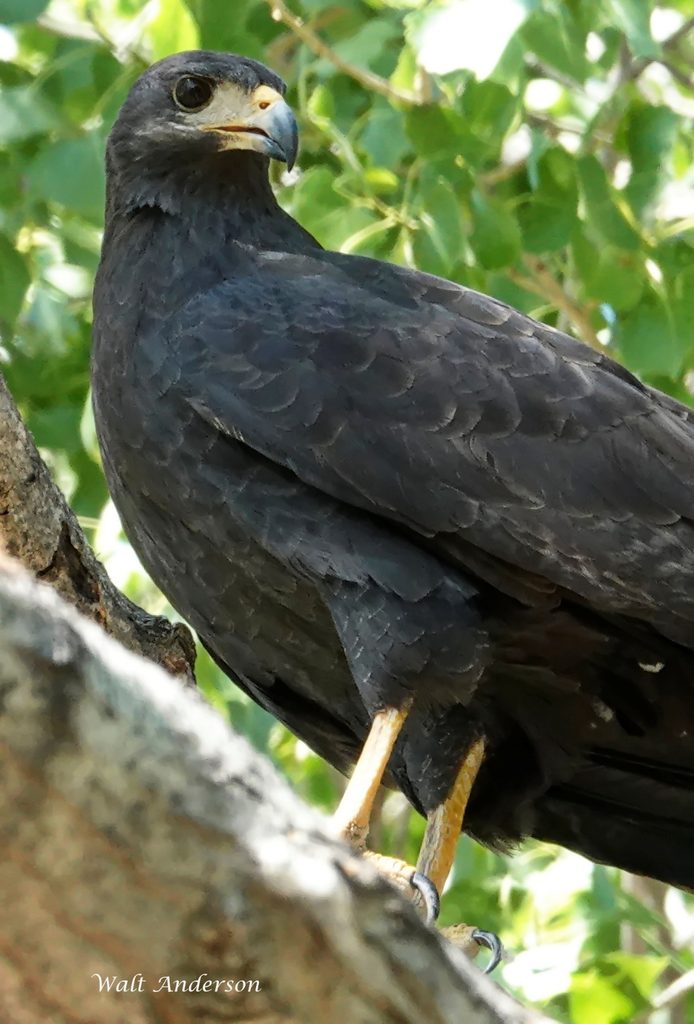
If you didn’t get that pun, it refers to the movie, Black Hawk Down, in which main characters include Black Hawk helicopters.
My photographer friend Everett was watching a Black Hawk in Watson Woods from the Peavine Trail when two men came up and asked what he was doing. He told them, but one man said, “That’s not a Black Hawk; it’s a raven.” Everett was surprised until he looked at the man’s jersey, which had the logo of the NHL club, the Chicago Blackhawks! Not at all like our bird!

This National Hockey League team logo certainly isn’t of a bird, though there are feathers. It refers to the famous Sauk chief, Black Hawk, who lived in what is now Illinois. His people sided with the British in the War of 1812 and sought to defend their homeland, which was being taken over, often by force, by American settlers. In 1832, the so-called Black Hawk war resulted. Though Black Hawk waved the white flag of surrender at the start of the Battle of Bad Axe, the Americans ignored it and proceeded to slaughter hundreds of indigenous people who were simply attempting to flee.
For years, Native Americans have been trying to get sports teams to respect their culture and eliminate logos that caricature them. Some teams have complied, but Chicago has not. Since our Black Hawks do not even occur in Illinois, there is no way they could substitute the bird for the symbol of the chief. It’s a sad commentary on our society that so few people are aware of a special bird, our Black Hawk, and yet they know of helicopters and sports teams that use that name.
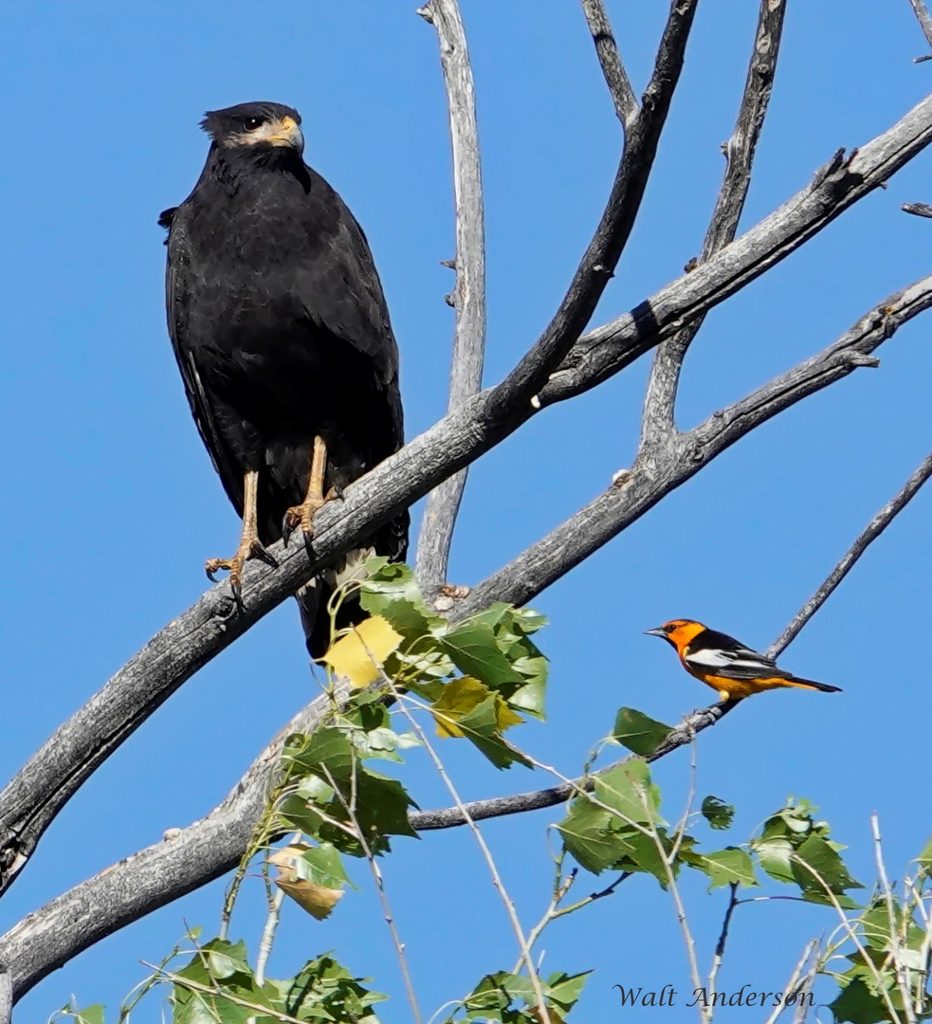
While people are often unaware of Black Hawks, they are part of a community of other species that encounter them. This Bullock’s Oriole is checking out a Black Hawk that probably invaded its territory. We forget that with many species of birds out there, their territories and home ranges overlap those of many others. The Black Hawk will defend its territory against other raptors but will simply ignore the oriole unless it’s foolish enough to offer itself as a tasty tidbit. The oriole or the kingbird, for example, will recognize the predator for what it is and sometimes mob it, perhaps hoping that harassment will get it to leave. Certainly, when a predator is being called out like this, it is ineffective in its hunting.
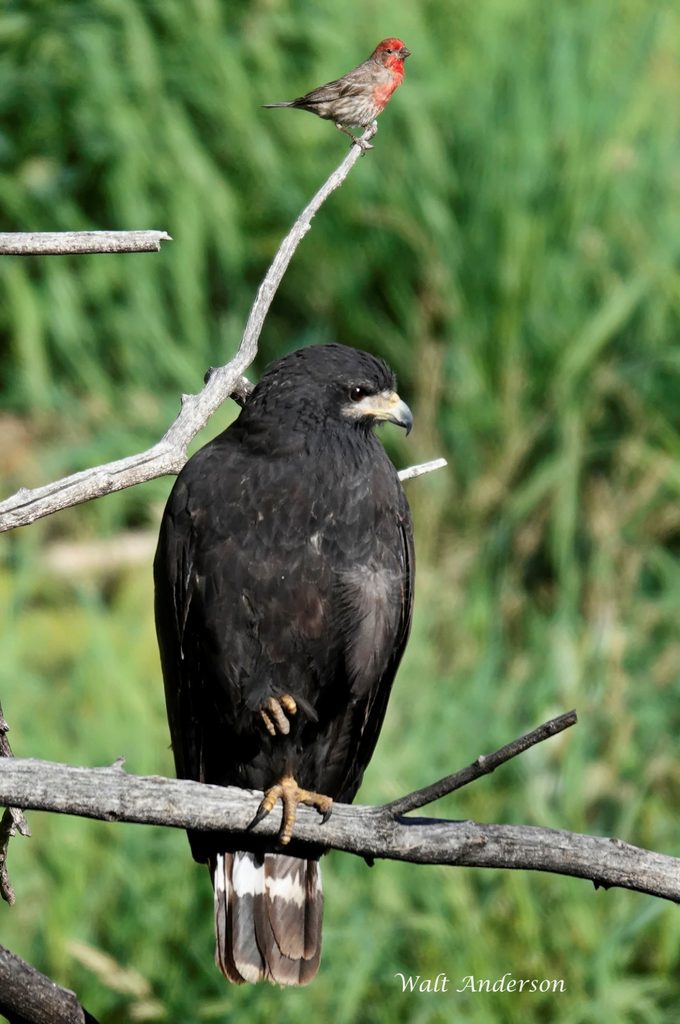
Just as many critters, ourselves included, will watch a snake with fascination (even fear at times), small birds may be attracted to raptors for similar reasons.
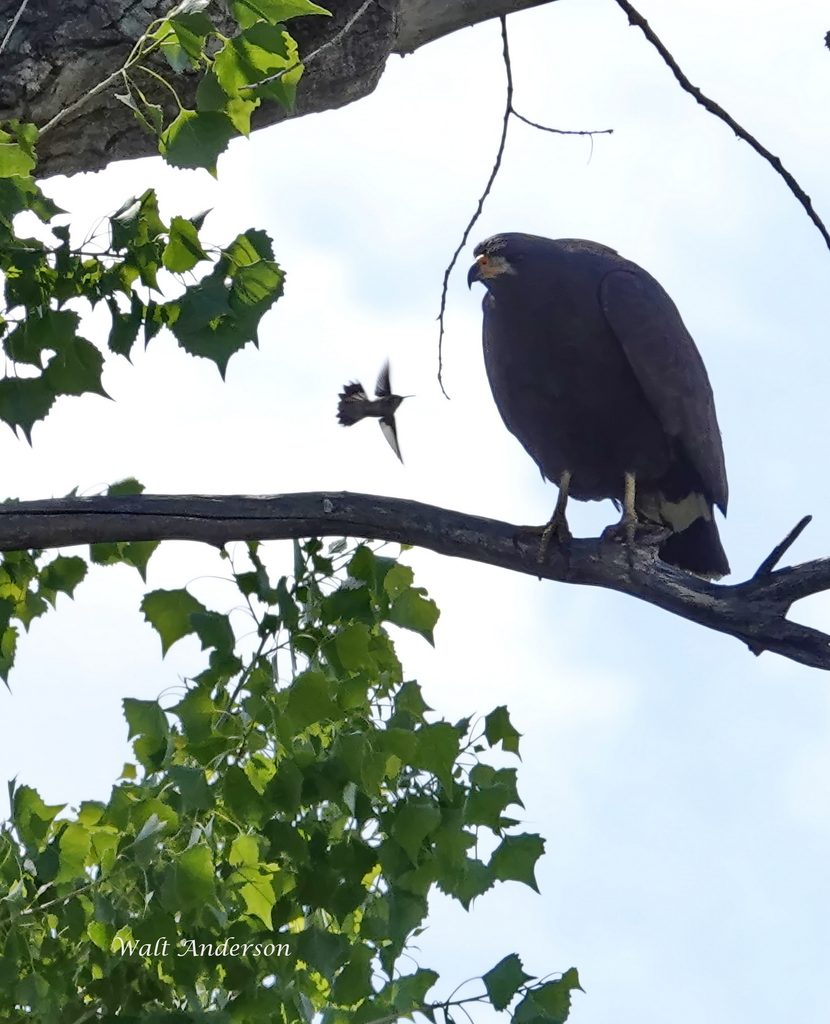
Bravery comes in all sizes.
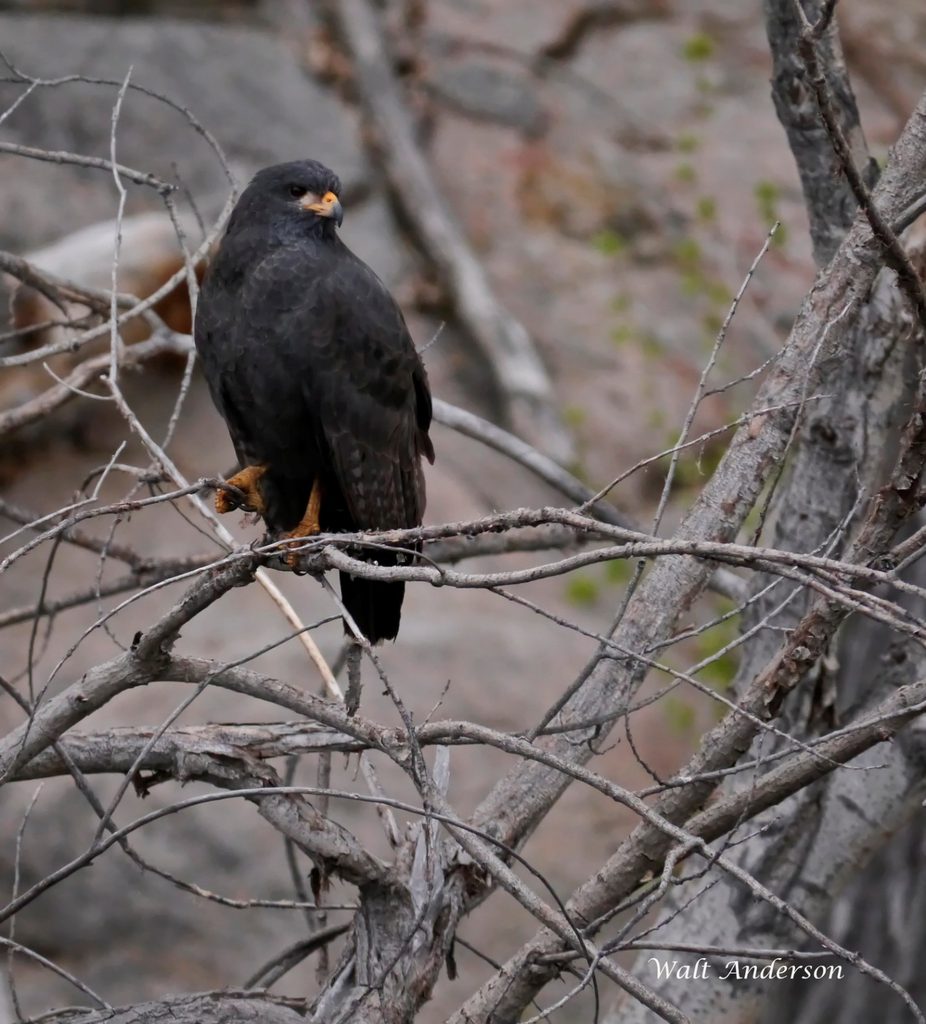
Our birds in central Arizona tend to arrive in the second half of March, often as riparian trees are just leafing out. They will leave again in fall, wintering somewhere in Central America, likely overlapping with non-migratory Black Hawks there. Frankly, this is something that needs good research. Our Arizona birds are much better studied than any of their more common kin south of the border!
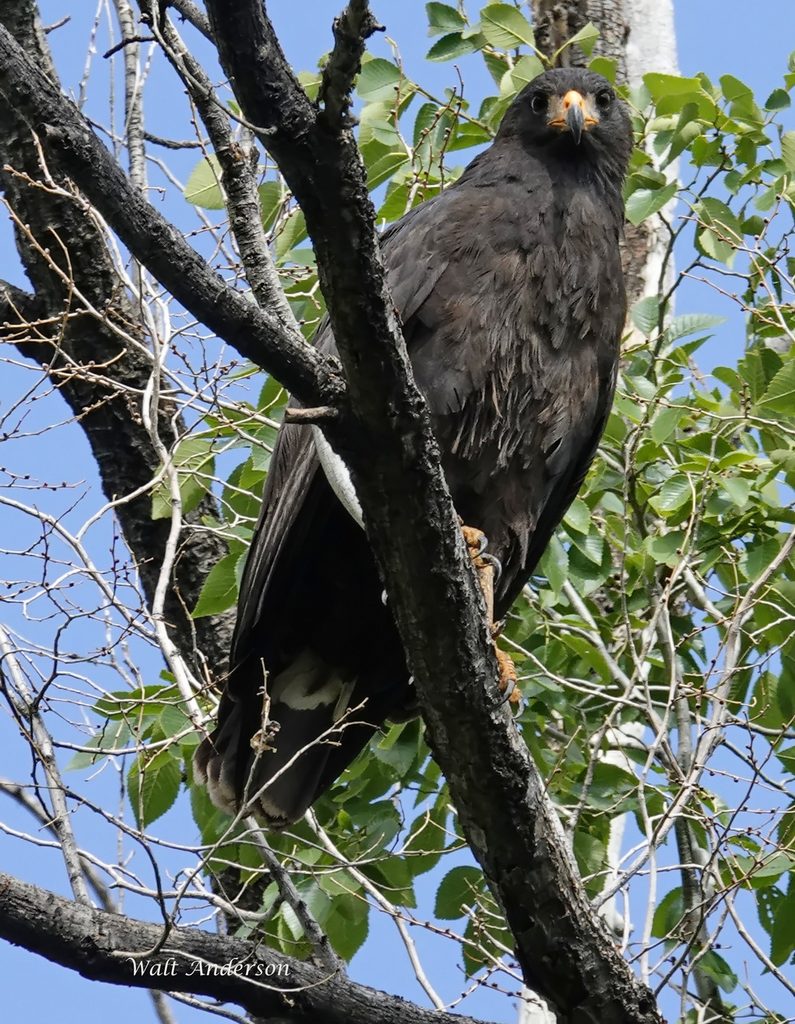
In recent years, ornithologists and birders have discovered that many of our hawks migrate along the Santa Cruz River (a shadow of its former self, by the way) on their way north in March. Volunteers collect data on all migrating raptors near Tubac south of Tucson. Sometimes dozens of hawks will be in the air at once. We have data from 2013 to 2026. The low count for Black Hawks was 164 in 2020, but a whopping 592 were recorded this spring! Counting effort was higher in the past three years, so results may not compare directly, though this is encouraging. Tubac now is a birder destination, bringing economic prosperity to a small town that otherwise depends a lot on art galleries.
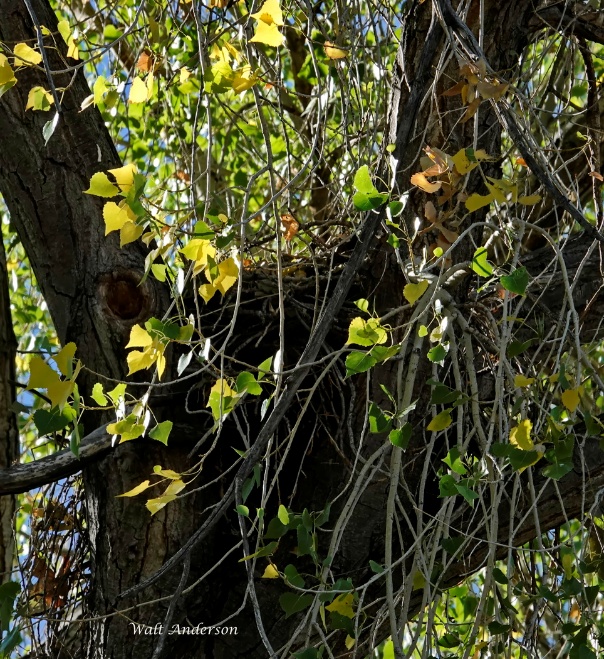
The solid fork of a large tree like a cottonwood provides structural security for a Black Hawk nest. Arizona has lost the vast majority of its riparian forests because of tree cutting, land conversion for agriculture or homes, groundwater pumping, and more. Even damming for reservoirs floods the narrow gallery forests and replaces them with relatively sterile reservoir shores, unacceptable to Black Hawks. Livestock grazing is a problem too, as it simplifies the understory where prey populations might live, and it prevents the recruitment of young trees that would eventually replace the older trees that die off. Heavily grazed groves of large cottonwoods, as we see here and there in Arizona, are the walking dead as ecosystems.
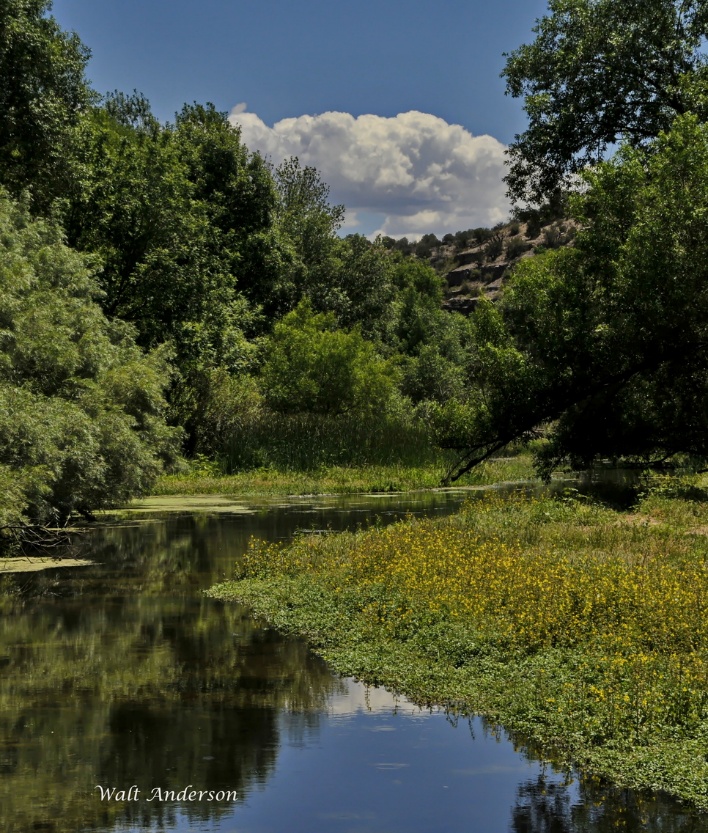
The good news is that removal of cattle from riparian areas can make a huge difference. When I first came to central Arizona in 1991, the Upper Verde River was an overgrazed wasteland, lacking connected groves of trees to shade the waters of the stream and provide wildlife habitat. Thanks to the Endangered Species Act, which allowed protection of threatened fishes by saving their habitat, cattle were removed, and the Verde River underwent a miraculous transformation. As habitat returned, so did the Black Hawks!
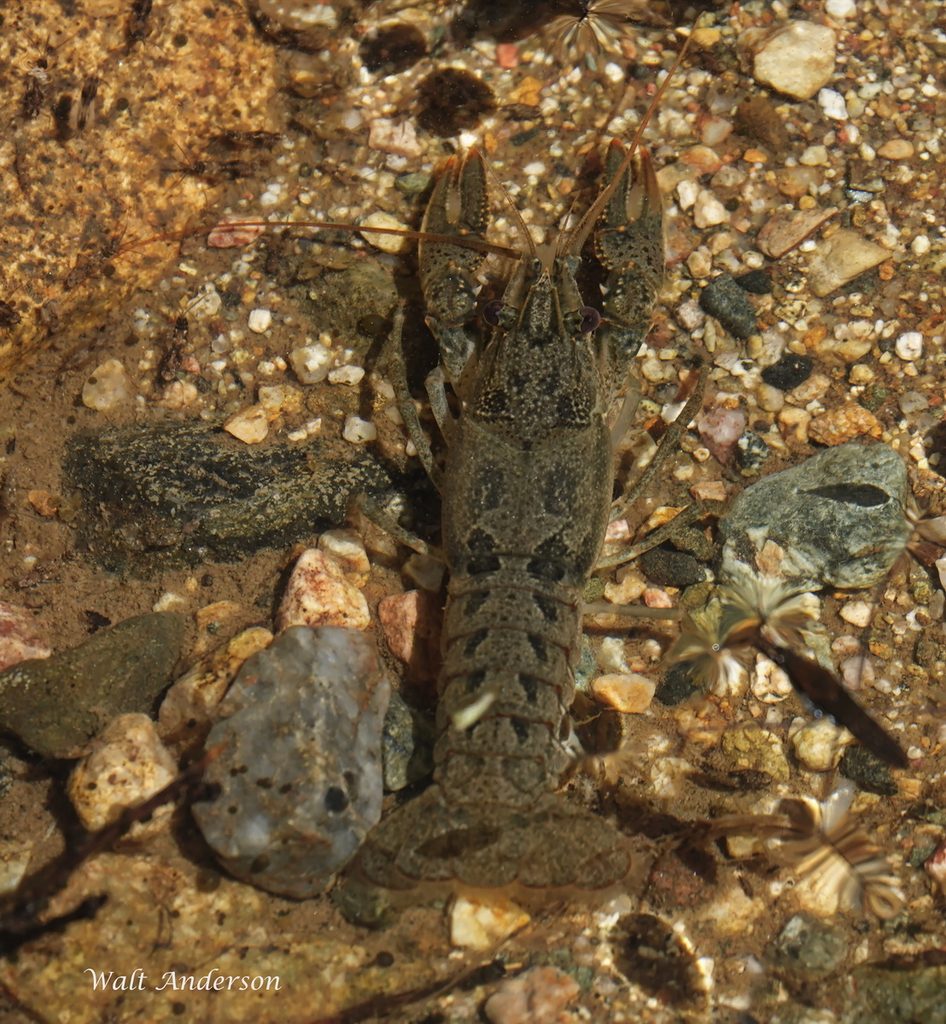
The Verde River ecosystem certainly has changed. Introduced crayfish, bullfrogs, bass, sunfish, etc. have replaced many of our native species. Black Hawks now eat these interlopers, though it is uncertain whether or not crayfish, for example, are as nutritious as the prey items the birds used to find.
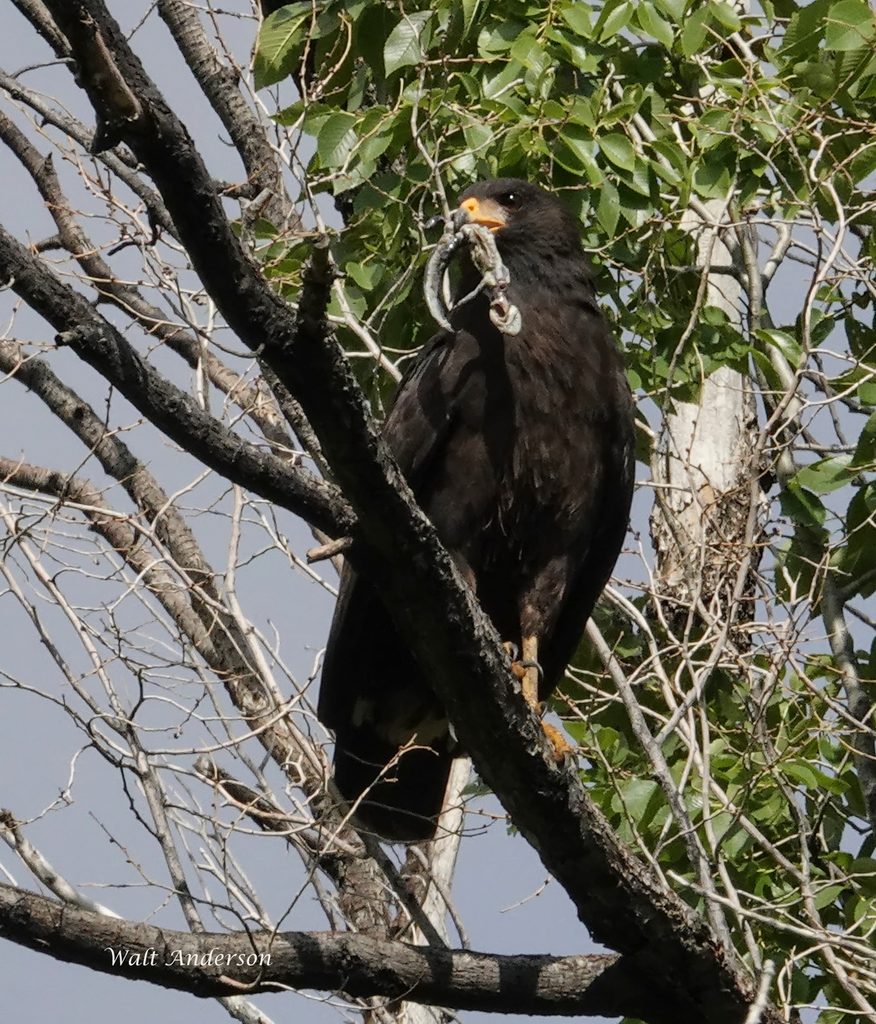
While we think of Black Hawks as riparian birds focusing on aquatic prey, they have been proven to be more versatile and opportunistic than we formerly thought. They can feed on snakes (garter snakes especially) and lizards, for example. This one has what appears to be a Tiger Salamander, typically a wetland species but rarely encountered in this area.
Black Hawks occasionally eat birds and mammals, small ones, for sure, but sometimes as large as shorebirds, herons, squirrels, or rabbits. Insects of many kinds, centipedes, clams, and turtles are fair game. Sometimes they cache prey and eat them later.
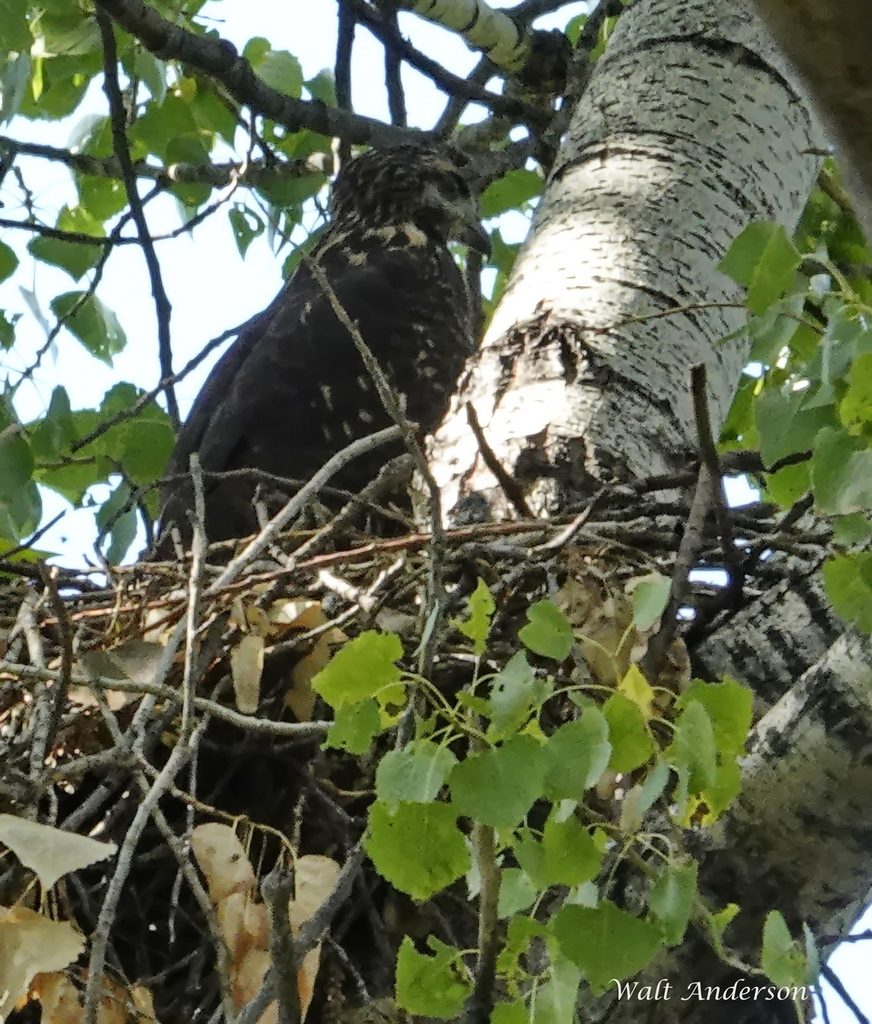
Young Black Hawks aren’t black at all. This one is just about to leave the nest as a fledgling, but it will be fed by its parents for a month or more before they all migrate south for the winter.
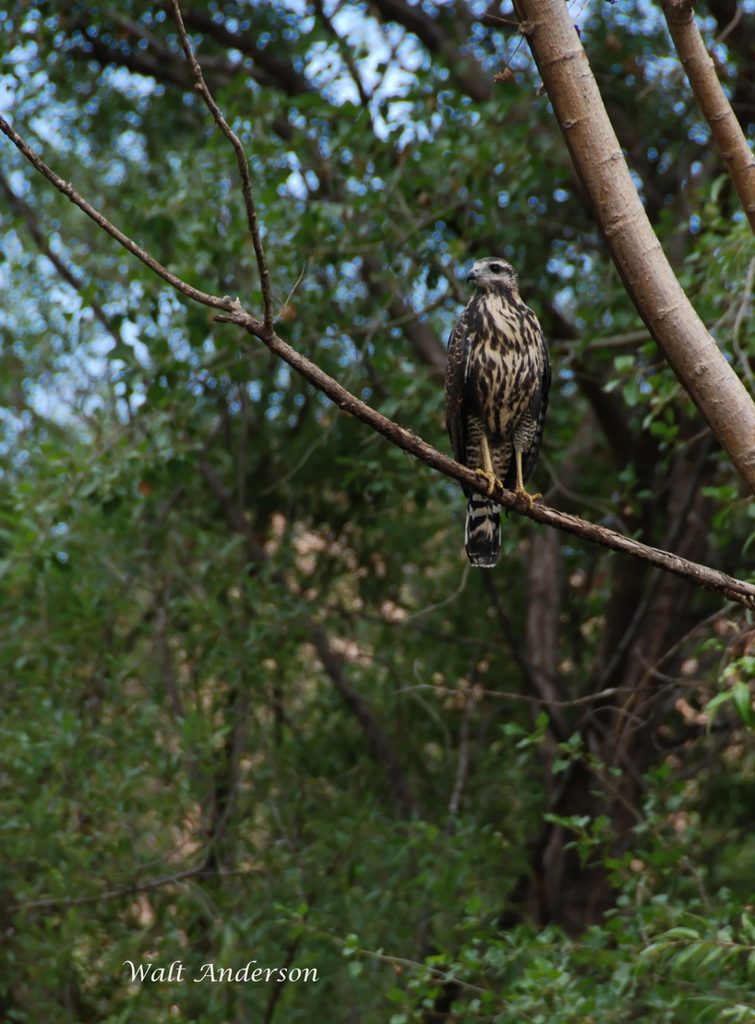
I photographed this young bird on 31 August. You might not even guess that this is a Black Hawk, as it is so different from the adult. Its tail is longer and has multiple bands. Its leggings are finely barred. There is no yellow on its bill, though it does have those long yellow legs like the adult. A bold, dark moustache and teardrops on its undersides are notable. In a year, it will be mostly black, and by two years, it is in full adult plumage.
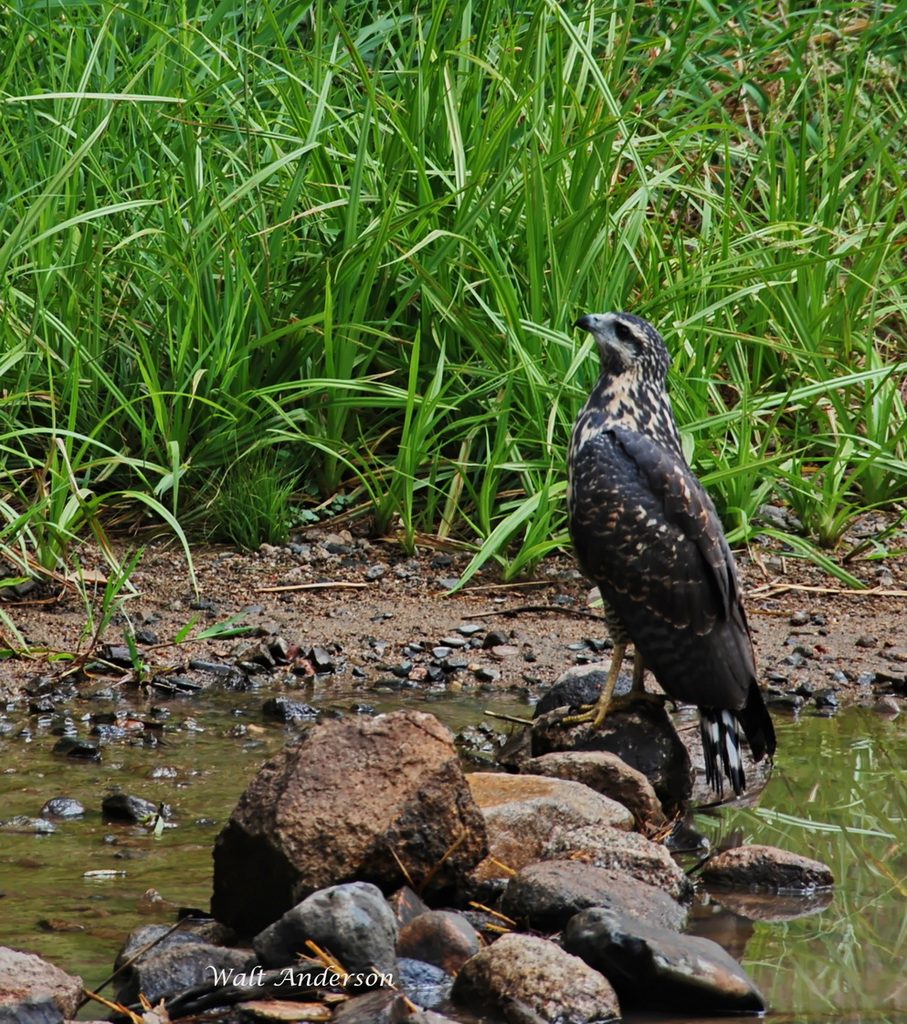
As I watched, the young bird dropped to the creek and began to search for prey. It will enter the water to chase fish, crayfish, or frogs, and those long stilts help.
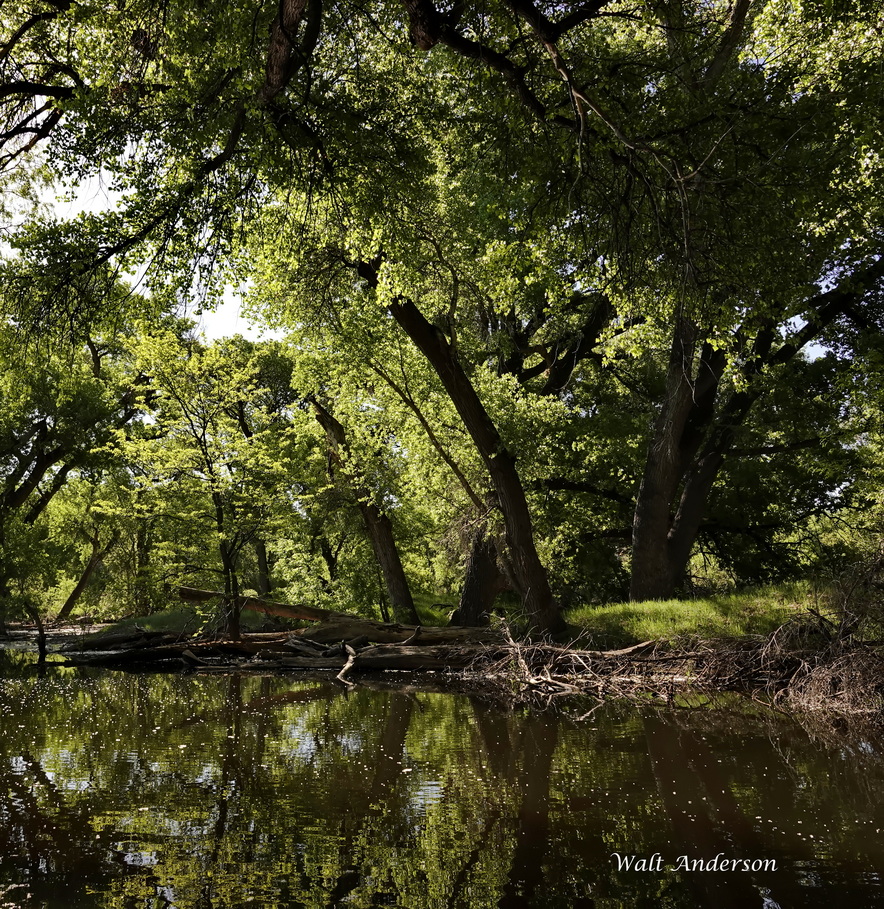
Several locations along Granite Creek host Black Hawk pairs, and one good spot to see them during the time of year they are here is this pond in Watson Woods. The nearby creek can go dry before monsoon rains refresh the flow, but usually there is water here and corresponding prey populations. Watson Woods is a happy story of riparian forest recovery once it stopped being used as an industrial site for rock material and became a preserve.
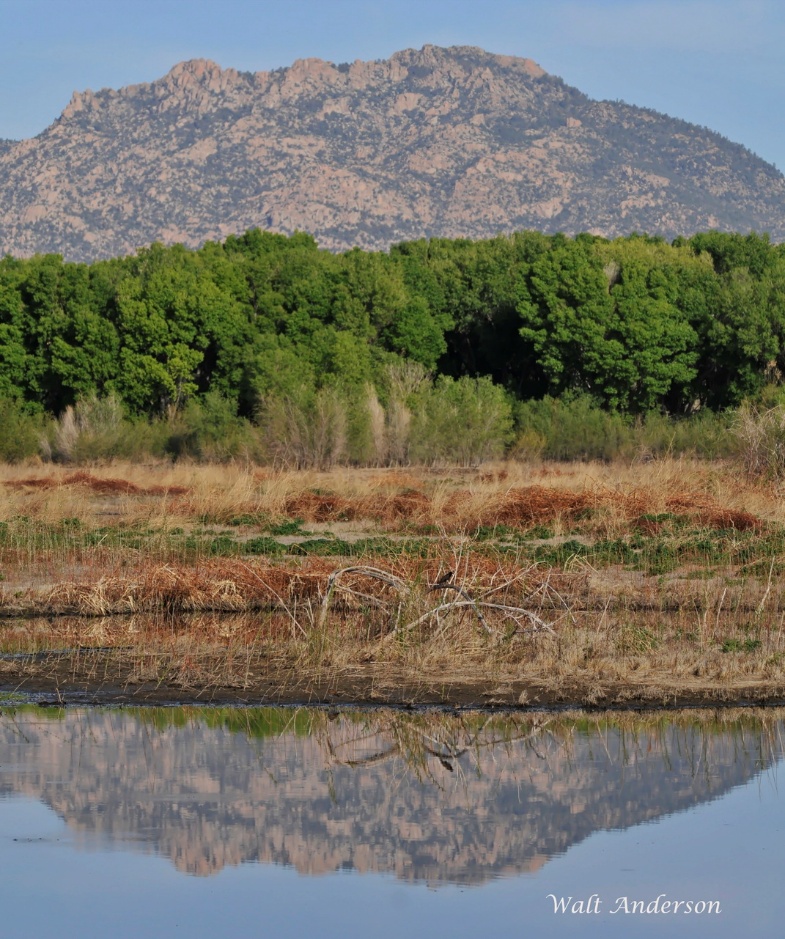
This year, I found an active nest in trees along the Cottonwood Peninsula at the far western end of Willow Lake. This was a bit surprising, as the birds are known to prefer being near running water, as you might find in Sycamore, Wet Beaver, or Clear Creeks. This image was taken in April 2013, and this year, there is no running or standing water anywhere close. The trees are there, but forget it with respect to aquatic prey.
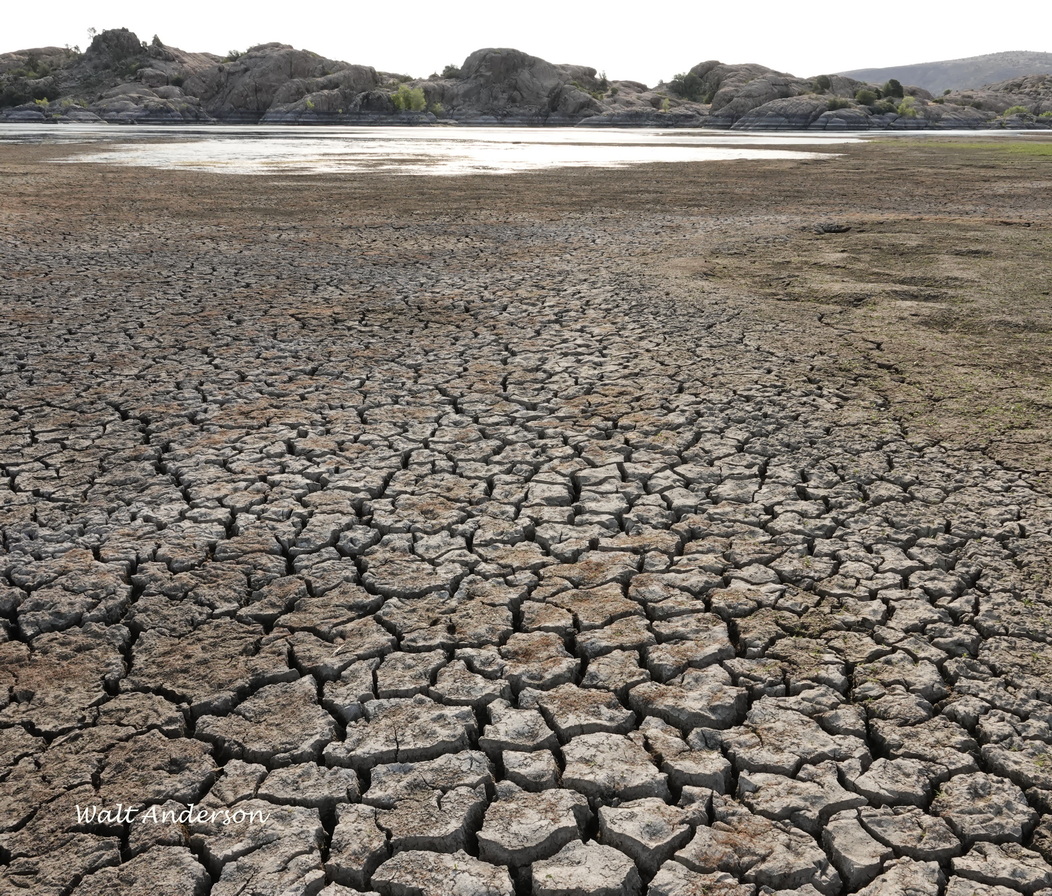
Here is what Willow Lake looked like last year, and it’s been no better this year. Water is probably a mile or more from the known hawk nest, and I have never seen a Black Hawk out in this kind of habitat. Yet somehow, they are nesting at the Cottonwood Peninsula. Maybe they are more flexible than we have long assumed. Since Willow Lake is no longer drained for agricultural uses in the Chino Valley area, and since cattle were removed, the west end of the “lake” has grown substantial groves of dense cottonwoods and willows. The City of Prescott appropriately treats this area as vital, protected wildlife habitat. And it’s working!
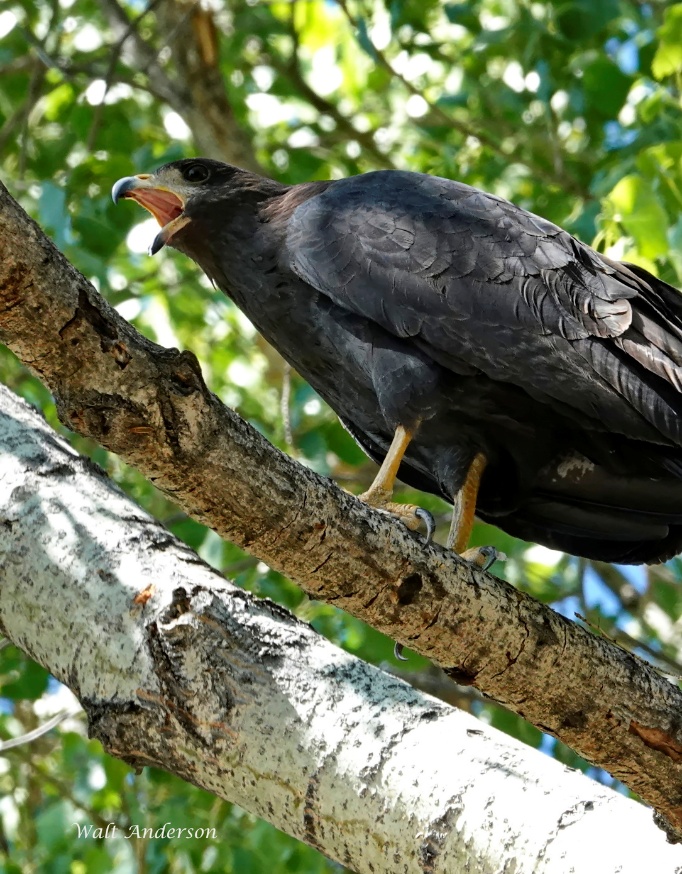
The Black Hawk has one of the most distinctive calls of any raptor. It’s a series of high whistles, short and sharp, that rise through several notes, then drop in pitch and intensity even as they accelerate. It’s called a “common call” (what else?), as it appears to have multiple functions ranging from contact between individuals to protests of alarm when the nest is approached too closely.
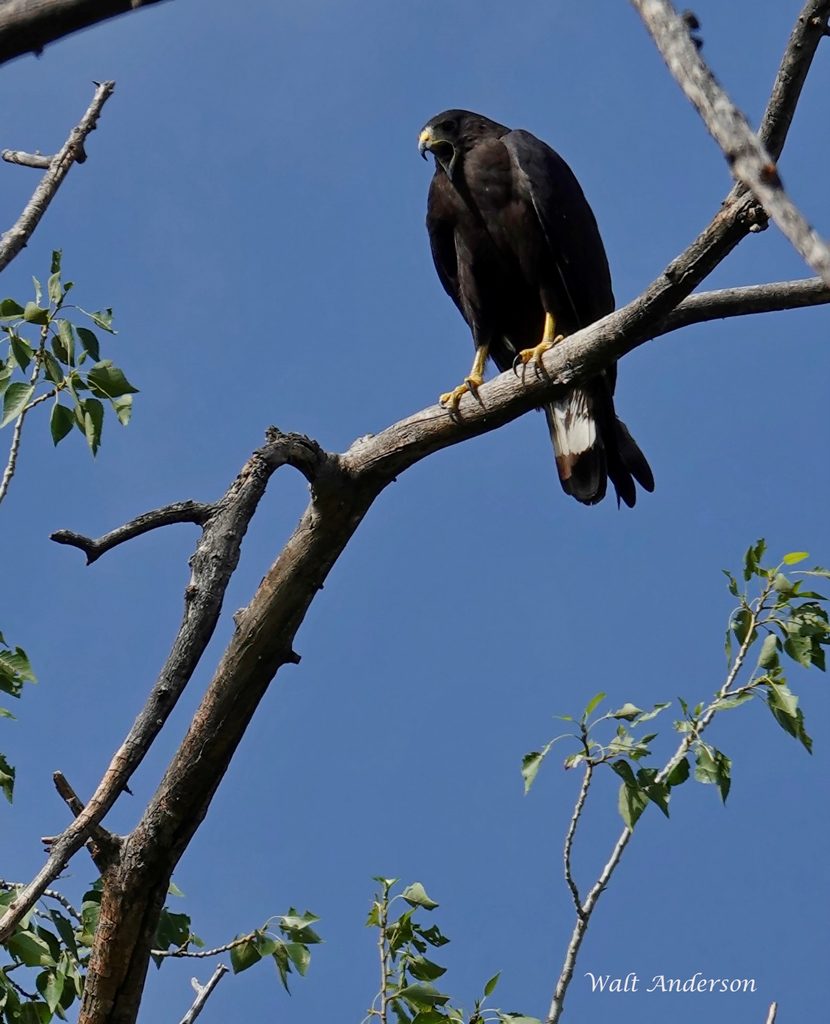
In contrast, the somewhat similar Zone-tailed Hawk, which can occur in the same area, has a long scream, somewhat like that of a Red-tailed Hawk (the latter scream often used in Hollywood movies for the sound of an eagle, whose true voice is less impressive). The Zonetail has a more rounded head, more bands on the tail, and longer wings, but you can see that if you didn’t hear the voice, you could easily be fooled. In fact, for much of the late 19th and early 20th Centuries, observers often confused the two, so early records that might be used to compare populations of each species then and now are just about useless.
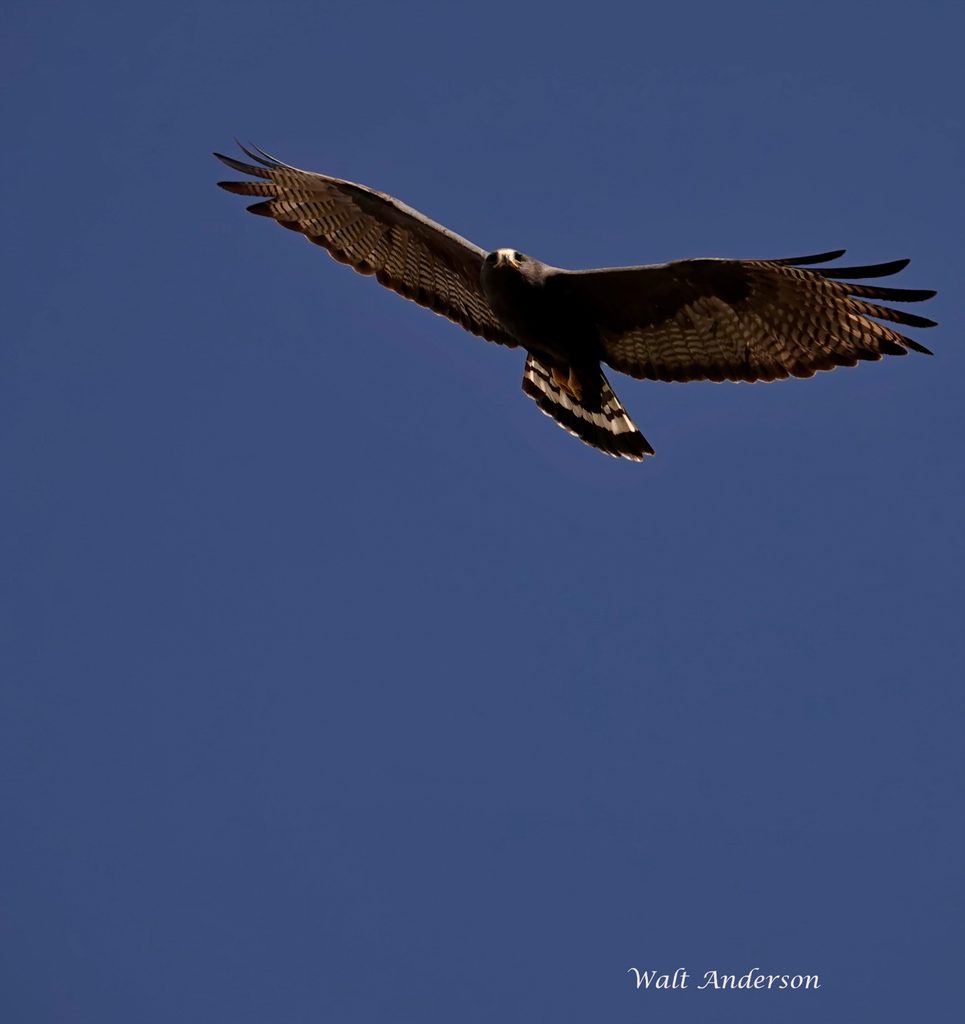
Yet if you see either bird in flight, it’s easy to tell them apart. The Zonetail flies with wings slightly uptilted in a dihedral, and underwing pattern resembles that of a Turkey Vulture, which it mimics to deceive potential prey into relaxing guard, thinking it’s harmless. The Black Hawk has very broad wings and a short tail with a broad, white band. It flies with wings held flat, and its overall appearance somewhat resembles that of a Black Vulture. Fortunately, both Zonetails and Blacks often call even in flight, and that makes ID easy.
Mostly gone are the days when every raptor is shot as a “chicken hawk.” Gone are the days of DDT, which severely depressed many bird populations by thinning eggshells. That is not to say that chemical contamination is no longer an issue. In western Yavapai County, copper and zinc leaching into streams from abandoned mines is known to have suppressed Black Hawk reproduction. Recently, PFAS concentrations have risen, potentially affecting all forms of wildlife but especially those higher in the food web. Insatiable water demand for new development is lowering water tables, meaning riparian areas may lose the source of their sustenance. Black Hawks are definitely not out of the woods.
But I still feel cautiously optimistic. Several prime habitats are now recognized as Important Bird Areas (e.g., the Upper Verde River, Page Springs and Oak Creek in the Verde Valley, Watson and Willow Ecosystem). Degraded riparian areas are recovering. More people are recognizing riparian areas as important to our quality of life.
The Black Hawk is a fitting symbol of a healthy riparian ecosystem that attracts these tropical birds to venture up into the Mogollon Highlands and beyond. No walls will stop them. Let’s do everything we can to not let the Black Hawk down!